
UK Citizenship & Naturalisation Translation Guide: Every Document You Need
Naturalisation is the last step in your UK immigration journey. After years of building a life here, you do not want a delay over a missing or poor translation. This guide covers every document you may need to translate for your Form AN application.
Why Naturalisation Is Different From Every Other Visa Application
When you apply to naturalise as a British citizen, you are not asking for permission to stay. You already have that. You are asking to join the British nation. The Home Office looks at naturalisation applications differently from visa or settlement ones. You must show residency and eligibility. You must also show good character, that you have settled into UK life, and that your identity holds up across your whole life. That can span several countries and several decades.
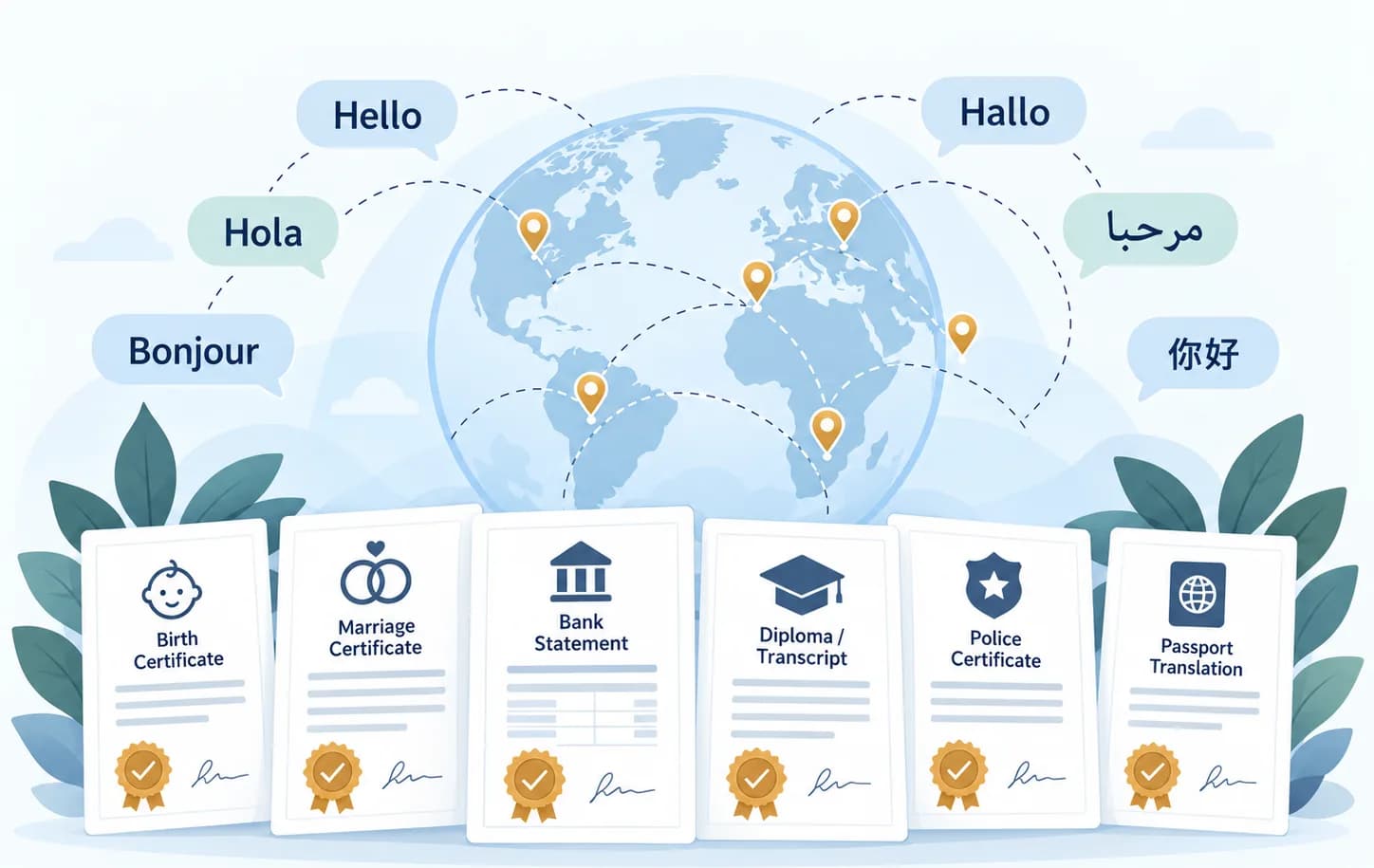
Many people breeze through a Skilled Worker visa, an ILR application and years of UK residence. Then the naturalisation paperwork surprises them. The reason is simple. Naturalisation looks back over your whole life, not just your time in the UK. You must account for every country you have lived in, every name you have used and every legal case you have been part of, anywhere in the world. Most of those records will need a certified English translation.
UKVI Translation Standard for Naturalisation
Every document you send with a naturalisation application must be in English or Welsh, or come with a full certified translation. The translation needs a statement signed by the translator. It must confirm they are qualified to translate and that the work is accurate. There are no exceptions. This covers police certificates, civil documents, court records and identity documents.
Form AN: The Naturalisation Application Framework
Form AN is the main application form for naturalisation as a British citizen. It is long: over 40 pages in the current version. You must give your full address history, your work history and every trip you took outside the UK. You must also declare any criminal convictions anywhere in the world and any civil penalties. Finally, you name two referees who can vouch for your character.
What you send with Form AN depends on your route, your country of birth, how many countries you have lived in and your own circumstances. Some types of document nearly always need translating, though. This guide goes through each one in turn.
Section 6(1) — Standard Residency Route
Five years of continuous lawful residence in the UK. You must hold ILR or settled status for the last 12 months of that. You do not need to be married to a British citizen.
Section 6(2) — Spouse/Civil Partner of British Citizen
Three years of continuous lawful residence. You must be married to, or in a civil partnership with, a British citizen. You do not need to hold ILR for 12 months first, though most applicants do have it.
Registration Routes
Some people register instead of naturalising. That covers children of British parents, people with an older claim to citizenship and a few other groups. The translation rules are much the same.
British Overseas Territories & Other Routes
Several routes exist under the British Nationality Act 1981 and later laws. You always have to translate identity and civil documents.
The Good Character Requirement and Translated Documents
The “good character” test sits at the heart of every naturalisation application. It is also the part that needs the most translated documents. Home Office guidance says you must declare any criminal conviction, civil penalty or legal case against you anywhere in the world, not only in the UK.
Police Certificates from Every Country You Have Lived In
UKVI wants police clearance certificates from every country where you lived for 12 months or more in the relevant period. For a Section 6(1) application, that period is the five years before you apply. For a Section 6(2) application, it is the three years before you apply. In practice, UKVI often asks for certificates going back further. That is most common for your country of birth and your country of nationality.
Do Not Overlook Historic Residency
Many applicants think only about their current country of nationality. They forget time spent studying, working or living with family somewhere else. Did you work in Dubai for 14 months in 2019? Then you need a UAE police clearance certificate, and it will almost certainly need translating.
People most often forget certificates from the UAE, Saudi Arabia, Qatar, South Africa, Australia and Canada. They also forget any EU country where they lived for work or study.
A police clearance certificate from a non-English-speaking country needs a full certified English translation. The translation must cover every part of the page. That includes headers, official stamps, certifying statements and any bad news, such as a list of charges or convictions. A part translation that only covers the “clear” result is not acceptable.
Court Records and Legal Proceedings
You must declare on Form AN any conviction, caution, penalty notice or civil case you have been involved in, anywhere in the world. If those records are in another language, you must supply certified translations of the court documents. This includes:
- Criminal conviction records — including minor ones that are spent under foreign law.
- Court judgments — including civil ones such as debt judgments, family court orders and custody rulings.
- Fixed penalty notices — you sometimes have to declare traffic fines and similar civil penalties.
- Administrative penalty records — some countries issue penalties that work like a caution does in UK law.
Do you think a foreign conviction is minor, or that it was pardoned? Declare it anyway and translate the papers. UKVI caseworkers check what you say against international police databases. Hiding something that shows up on their checks is treated far more seriously than the offence itself.
Identity Documents Requiring Certified Translation
Your identity must be clear and consistent right across your naturalisation application. Every version of your name on every document must trace back to you. That is why translating identity documents matters so much.
Core Identity Documents
- Birth Certificate
Your birth certificate is the base identity document for any naturalisation application. If it comes from a non-English-speaking country, translate all of it. That means your parents' names, your place of birth, and any note in the margin or registry stamp. If the certificate uses a non-Latin script such as Arabic, Chinese, Cyrillic or Devanagari, every character must be translated and transliterated.
- Passport (Foreign-Language Pages)
Most modern passports show the personal data page in the national language and in English. Older passports and a few national passports do not. Any page that appears only in the national language must be translated. That covers the biographic data page, any handwritten notes and any endorsement page that relates to your immigration history.
- National Identity Card
EU and EEA national ID cards usually print their labels in the national language. Your name may be in Latin script, but fields such as date of birth, place of birth and issuing authority may still need translating. ID cards from outside the EU are nearly always in the national language only, so they need a full translation.
- Name Change Deeds and Marriage Certificates (Name Evidence)
Do you use a different name from the one on your birth certificate? Perhaps through marriage, a deed poll or a customary name change. You must then show a clear chain of evidence linking the names. Translate every document in that chain that is not in English. That includes overseas marriage certificates, official name change notices and statutory declarations made abroad.
Residence Evidence and Translation Requirements
You must show continuous lawful residence in the UK for the qualifying period. UKVI wants proof of residence at regular points across that time. If any of that proof comes from abroad, it will need translating.
Most applicants can prove UK residence with UK documents alone, such as P60s, bank statements, council tax notices and NHS records. Those are already in English. A few common situations still call for translated overseas documents:
Overseas Bank Statements
Did you keep an overseas bank account while living in the UK, and do you want to use it as evidence? Then any statement in another language must be translated. This comes up most often for spouse visa applicants who ran joint finances across two countries.
Overseas Utility Bills
You rarely need these for UK naturalisation. They can help where your UK address evidence is thin for a period. Any overseas utility bill you use as proof of residence must be translated.
Employment Letters from Overseas Employers
Your Section 6(1) qualifying period may include work for an overseas company. A multinational that contracts through a non-UK entity is one example. Any letter from that employer in another language must be translated.
Overseas Tax Records
Some applicants send overseas tax returns or tax clearance certificates to help prove their lawful status. If those are not in English, they need a certified translation.
The English Language Requirement and Translation
To naturalise as a British citizen, you must show you speak English to at least B1 level of the Common European Framework of Reference. Welsh or Scottish Gaelic also count. You can meet this in several ways, and a few of them involve translation.
The simplest proof is a UK degree taught in English. A recognised English test also works, such as IELTS or a SELT from an approved provider. So does being a national of an exempt country such as Australia, Canada, New Zealand or the USA. None of these need translating.
When Translation Arises for English Language Evidence
- Overseas degree transcripts: Relying on an overseas degree taught in English? You may need a certified translation of the certificate or transcript to prove the teaching language.
- Professional qualifications: Some applicants use a professional qualification gained abroad to show their English. Any paperwork for it in another language must be translated.
- Academic transcripts from non-English institutions: If you use an overseas academic record as evidence for anything in your application, it may need a certified translation. That holds even when you prove your English another way.
The Life in the UK Test and Supporting Documents
The Life in the UK test is taken in English and the pass notification comes in English. So the certificate needs no translation. Some applicants still hit a problem. They may have lost the certificate, or the name on it may not match the name on their application after a name change.
In those cases you may need extra documents to close the gap. That evidence may come from abroad, such as a marriage certificate showing your name change. It will need a certified translation, even though the test itself was in English.
Children's Naturalisation: Additional Documents
A child can naturalise with a parent, or on their own. It depends on their situation. The translation rules for a child are extra. They do not replace the parent's. So if you are naturalising with a dependent child, expect more documents to translate.
Documents for Children's Naturalisation
- Child's birth certificate — if it was issued abroad and is not in English, it needs a full certified translation. That includes both parents' names, exactly as written.
- Overseas school records — UKVI may ask for proof of where the child has lived and how they have settled in. It sometimes asks for school records from abroad, above all for older children. Any school record, enrolment certificate or leaving certificate not in English must be translated.
- Custody agreements or court orders — if the parents are separated or divorced, UKVI wants proof that the applying parent may apply for the child. If a foreign court set the custody terms, those orders must be translated. People forget this one more than any other.
- Other parent's consent — is the other parent not British, and not applying with you? UKVI may ask for proof of their consent or of their own legal status. Any such paper in another language must be translated.
- Adoption orders — if the child was adopted abroad, translate the foreign adoption order in full.
Registration vs Naturalisation: Translation Requirements Compared
Registration and naturalisation are two separate routes to British citizenship. Registration is mainly for people who already had a right to citizenship but never claimed it as a baby or child. It also covers children born to British parents in some cases. Naturalisation is for adults who earn citizenship by living here.
The forms differ. Form MN1 covers registration of a child, Form B(OTA) covers British Overseas Territories, and Form T covers various registration routes. The translation rules are the same for all of them: every non-English document you send as evidence needs a certified translation.
There is one difference worth knowing. Registration cases often involve much older papers: grandparents' records, or parents' birth and marriage certificates from decades ago. Those may be in poor shape or use dated wording. They need a translator who knows how documents of that era were laid out in the language. A standard translation service can handle them. Just say how old and how worn the documents are when you order.
Complete Document Checklist by Naturalisation Route
| Document | Section 6(1) Residency | Section 6(2) Spouse | Registration |
|---|---|---|---|
| Birth certificate (yours) | Required — translate if non-English | Required — translate if non-English | Required — translate if non-English |
| Passport (foreign-language pages) | Translate if needed | Translate if needed | Translate if needed |
| Police certificate (country of birth) | Required — translate | Required — translate | May be required — translate |
| Police certificates (other countries lived in 12+ months) | Required — translate each | Required — translate each | May be required — translate |
| Marriage/civil partnership certificate | If applicable — translate if non-English | Required — translate if non-English | If applicable — translate if non-English |
| Divorce decree(s) | If applicable — translate | If applicable — translate | If applicable — translate |
| Children's birth certificates | If naturalising children — translate | If naturalising children — translate | Core document — translate |
| Custody agreements / court orders | If applicable — translate | If applicable — translate | Often required — translate |
| Court records / convictions | If applicable — translate in full | If applicable — translate in full | If applicable — translate in full |
| Academic transcripts / qualifications | If used as evidence — translate | If used as evidence — translate | If used as evidence — translate |
| Overseas employment letters | If used as evidence — translate | If used as evidence — translate | Rarely required |
| Parent's birth certificate (registration routes) | Not applicable | Not applicable | Often required — translate if non-English |
Common Reasons Naturalisation Applications Are Delayed Due to Translation Issues
UKVI handles hundreds of thousands of naturalisation applications a year. It usually returns or pauses an application with a translation problem rather than refusing it. Even so, a return can add months to your wait. Knowing the common causes helps you avoid them.
1. Missing Police Clearance Translations from Overlooked Countries
This is the most common problem. Applicants send the police certificates but forget the certified translations. Or they send certificates from their country of birth and nationality, then forget a country where they lived briefly for work or study. UKVI then asks for what is missing, and your case stops while you find it.
2. Translation Does Not Cover the Entire Document
Some providers translate only the “main” text. They skip official stamps, signatures, certifying notes and notes in the margin. UKVI wants the whole document translated. Stamps that name the issuing court, notary office or registry are part of what makes the document valid, so they must be translated too.
3. Name Inconsistencies Across Translated Documents
Turning a name from a non-Latin script into English can give different spellings. It depends on the translator and the system they use. Say your name is spelled one way on your birth certificate translation, another on your police certificate translation and a third on your form. UKVI will then ask you to explain. Use the same system on every document, or add a note explaining why they differ.
4. Translator's Certification Statement Is Absent or Inadequate
UKVI wants every translation to carry a signed statement from the translator. It must confirm they are qualified and that the work is accurate. Machine output is not accepted. Nor is a translation with no named translator, or one with a standard statement and no signature.
5. Expired Police Certificates Translated Too Late
A police clearance certificate is usually valid for 6 months from the date of issue. Some applicants order the translation months after the certificate arrives. If the certificate then expires before UKVI looks at the file, you need a new certificate and a new translation. Order the translation as soon as the document arrives.
6. Custody Agreements and Children's Documents Not Translated
When naturalising a child, applicants often translate all of their own papers and forget the child's. Custody agreements, the child's birth certificate and school records all need translating if they are not in English.
The Citizenship Ceremony and Document Translation
Once UKVI approves your application, your local council invites you to a citizenship ceremony. The ceremony needs no translated documents. Bring your invitation letter and turn up.
One issue can come up afterwards, though: confirming your name. Your British citizenship certificate shows the name from your application. Later you may use a foreign-language document to prove who you are, such as a marriage or birth certificate. If the names do not match, you may need a certified translation to link them. That matters when you apply for a British passport or register with HMRC.
Name Discrepancy at the Ceremony Stage
UKVI puts the name from your Form AN on your citizenship certificate. Suppose you used a spelling that differs slightly from the one on your passport. That difference then follows you onto your citizenship certificate, and then onto your British passport application.
Spot a name mismatch before your ceremony? Contact UKVI at once. After the ceremony, a correction needs a formal application and a fee. Make your name match across every document before you send Form AN, and the problem never starts.
Can You Reuse Translations from Your ILR Application?
This is one of the questions we get most, and the answer is yes for documents that do not change. Certified translations do not expire the way police certificates do. Did you have your birth certificate, marriage certificate or divorce decree translated for your ILR application? You can use those same translations again for naturalisation.
The rule is simple. The document must not have changed, and the translation must match the copy you now send. A photocopy of the same birth certificate with the same translation is fine. But you may have ordered a newer copy from your country of birth. The caseworker will compare that copy with the translation. If the new copy has different printing, stamps or layout, get a fresh translation to avoid confusion.
Safe to Reuse from ILR
- Birth certificate translation
- Marriage certificate translation
- Divorce decree translation
- Academic qualification translations
- Historical employment records
Always Needs Fresh Translation
- Police clearance certificates (expire ~6 months)
- Bank statements (time-sensitive)
- Employment reference letters
- Any document that has been updated or reissued
- Documents with new stamps or annotations added
How to Order Translations for Your Naturalisation Application
Audit All Your Documents Against the Checklist
Before you upload anything, work through the full checklist for your route. List every non-English document you may have to send. Include police certificates from every country where you lived 12 months or more. This one step prevents the most common cause of delay.
Upload All Documents in a Single Order
Upload your whole set of documents at once. Then the same translator or team handles them all, so your name is spelled the same way throughout. You also get one complete package back, instead of files arriving in dribs and drabs.
Note the Preferred Transliteration of Your Name
Is your name in a non-Latin script? Add a note when you order. Tell us the spelling you use on Form AN and on your current passport. UKVI checks names closely, so the same spelling must appear on every document.
Receive UKVI-Compliant Certified Translations
Each translation arrives as a certified PDF. It carries a signed statement from the translator, their name and contact details, and a statement of accuracy. The format meets every UKVI rule for naturalisation applications.
Organise Your Translation Package
Put your translated documents in the same order as the supporting documents section of Form AN. Keep each translation right behind the original it belongs to. That makes the caseworker's job easier and cuts the risk of a document being flagged as mismatched.
Frequently Asked Questions — Naturalisation Translation
Do I need to translate my police certificate if it says “no criminal record” in English?
It depends on whether the whole document is in English. Many countries issue police certificates in two languages, side by side. If the English side carries everything, you need no translation. That means your name, date of birth, issuing authority, date of issue and the clearance statement. But if any part shows only in the national language, you need a full certified translation of the whole document. That includes official headers, stamps and the certifying officer's details. When in doubt, translate it. A translation costs far less than a delay.
How long does certified translation take for a naturalisation application?
Standard turnaround is 24 hours per document. A typical naturalisation application has 5–10 documents, so the full package is usually ready in 24–48 hours. If you are in a hurry, rush 8-hour processing is available. Allow 48 hours for large sets, or for documents in complex scripts. Translation is not the slow part of naturalisation. Getting the police certificates is. Some countries take weeks.
My birth certificate is in very poor condition. Can it still be translated?
Yes, in most cases. Professional translators work with aged, faded and damaged papers all the time. Where text really cannot be read, the translation says so, for example “[text illegible]”. If your birth certificate is in very poor shape, think about ordering a fresh certified copy from the registry in your country of birth. UKVI may doubt a document it cannot read, however good the translation is. If you cannot get a replacement, send a covering note that explains the condition.
Can I use the same translation for both my ILR and my naturalisation application?
Yes, for documents that do not change, such as birth certificates, marriage certificates and divorce decrees. Certified translations do not expire. If you translated your birth certificate for your ILR application, send that same translation with the same original for naturalisation. Time-sensitive papers are different. Police certificates and bank statements must be new, so their translations must be new too.
What if my country of origin cannot issue a police clearance certificate?
Some countries cannot issue police clearance certificates. This usually applies to countries hit by war or by the collapse of the state. UKVI guidance accepts this and lets you explain in writing. Send a signed statement setting out the situation, plus proof that you tried, such as formal letters from the authority. Translate any reply you get that is not in English. If you are in this position, speak to a qualified immigration solicitor.
Related Services
Continue Reading
UK Visa Document Checklist 2026
The complete checklist for every UK visa type including naturalisation
Police Clearance Certificate Translation
How to translate police certificates for UK visa and citizenship applications
Birth Certificate Translation for UK Visa
Complete guide to getting your birth certificate translated for UKVI
UK Citizenship Naturalisation Translation Documents
Document-by-document breakdown for naturalisation applicants
Ready to Translate Your Naturalisation Documents?
Upload your full set of Form AN supporting documents. We deliver UKVI-certified translations within 24 hours. All languages, all document types.
Start Your Naturalisation Translations