
Birth Certificate Translation for UK Visa: Complete 2026 Guide
You need your birth certificate for almost every UK visa route. This guide shows you how to get it translated correctly for UKVI.
The birth certificate is the document people translate most often for UK visa applications. Are you applying for a spouse visa, a student visa, settlement, or citizenship? Then you will almost certainly need a certified birth certificate translation. This guide covers it all: what UKVI asks for, what changes from country to country, and what to do when names do not match.
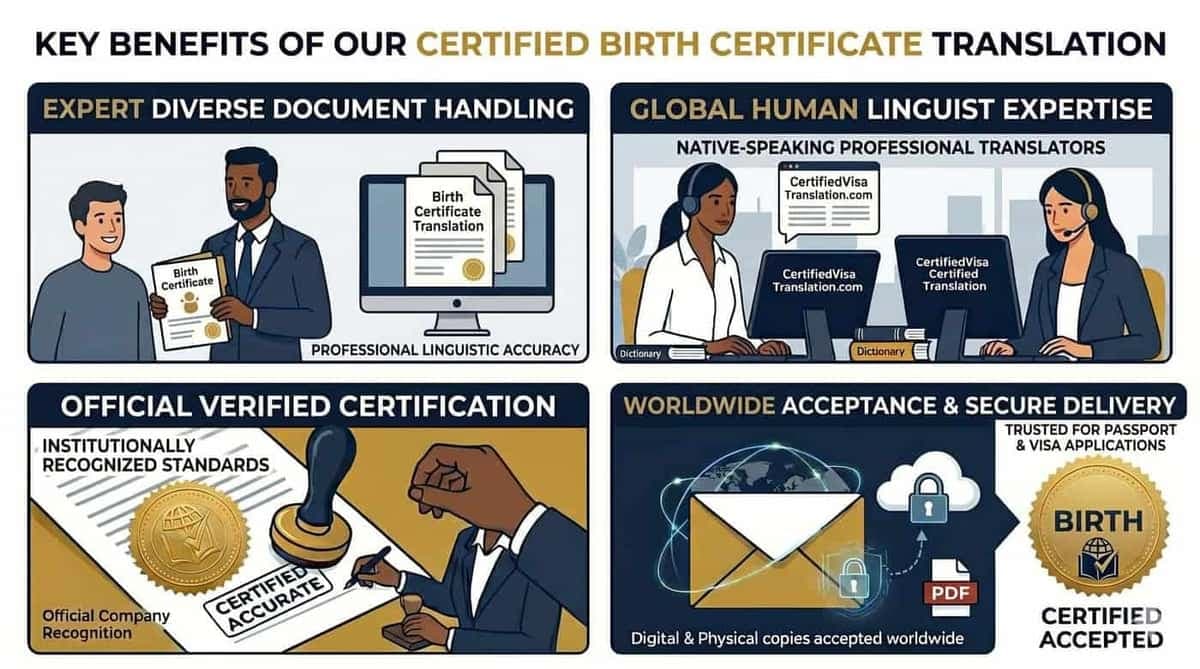
Key benefits of our certified birth certificate translation service
Which UK Visas Require Birth Certificate Translation?
| Visa Type | Required? | Notes |
|---|---|---|
| Spouse/Partner Visa | Required | Both partners' birth certificates |
| Student Visa | Required | Part of identity evidence |
| Skilled Worker Visa | Usually Required | Depends on sponsor requirements |
| Settlement (ILR) | Required | For applicant and dependents |
| Standard Visitor Visa | Sometimes | Only if requested by caseworker |
| Citizenship/Naturalisation | Required | Essential for identity verification |
| Global Talent Visa | Usually Required | Part of evidence portfolio |
| Ancestry Visa | Required | For you AND your UK-born grandparent |
UKVI Requirements for Birth Certificate Translation
Certification Checklist
- A signed translator declaration that says the work is accurate and complete
- Translator's full name, qualifications, and contact details
- Date of translation clearly stated
- The type of the original document and the name of the authority that issued it
- All text translated — stamps, seals, and notes in the margins as well
- Name transliteration matches passport spelling
What Needs to Be Translated
Every part of your birth certificate that has text on it must be translated. This is where many do-it-yourself translations go wrong. They cover the main text but miss the parts caseworkers check:
Personal Details
- • Full name at birth (and any subsequent changes)
- • Date of birth
- • Place of birth (city, district, region)
- • Gender
Parent Information
- • Parents' full names
- • Parents' dates and places of birth
- • Parents' occupations (where listed)
- • Parents' nationalities
Official Details
- • Registration number
- • Date of registration
- • Registrar's name and title
- • Issuing authority name and address
Often Missed Elements
- • Margin annotations (name changes, corrections)
- • Official stamps and seals (describe content)
- • Watermarks and security text
- • Text on reverse side of document
Margin Annotations Are Critical
Many birth certificates have handwritten or stamped notes in the margins. They record things like a name change after marriage, legitimation, or a correction. These notes carry legal weight, so they must be translated. Caseworkers look for them to check name changes and family links.
Country-Specific Considerations
Birth certificates look very different from one country to the next. Here is what to know about the countries UK visa applicants come from most:
India
Indian birth certificates come in several formats. It depends on when and where they were issued. Municipal corporation certificates, from cities like Mumbai, Delhi, and Chennai, differ from those issued by village panchayats. Newer certificates from the online CRS (Civil Registration System) are mostly the same as each other. Older ones may be handwritten in Hindi, Tamil, Bengali, or another regional language. Whatever the format, all the text must be translated.
Read our Hindi document translation guide • Bengali document translation guide
Pakistan
Pakistan uses two main formats. The first is the modern NADRA computerised birth certificate. The second is the older Union Council certificate, often handwritten in Urdu. NADRA certificates carry both Urdu and English text, but the Urdu parts still need certified translation. Older certificates often have Urdu stamps that are easy to miss.
Read our Urdu document translation guide
Nigeria
Nigerian birth certificates from the National Population Commission (NPC) are usually in English. But certificates from local government areas (LGAs) may have text in Yoruba, Igbo, or Hausa. Some older ones are in a local language throughout. Even a Nigerian certificate in English sometimes needs a certification letter to confirm that it is genuine and complete.
China
A Chinese notary public must notarise a Chinese birth certificate before you can use it abroad. You then translate the notarised copy, not the original one from the hospital. These documents are written fully in Simplified Chinese. Watch out for names: the Pinyin spelling on the certificate may not match the spelling in your passport.
Read our Chinese document translation guide
Poland
Polish birth certificates (Odpis aktu urodzenia) come in two forms. The full copy (odpis zupełny) shows every margin note and change. The short extract (odpis skrócony) shows only the key facts. For visa applications, use the full copy, because it shows the whole history. Polish accent marks (ą, ę, ó, ś, and so on) must be transliterated correctly.
Read our Polish birth certificate translation guide
Name Discrepancy Issues
Names that do not match are one of the most common problems with birth certificate translations. When your name comes from a non-Latin script, there is often more than one correct spelling in English. So your birth certificate may use one spelling and your passport another.
Common Transliteration Discrepancies
- • Arabic: محمد → Mohammed, Muhammad, Mohamed, Muhammed
- • Russian: Александр → Aleksandr, Alexander, Alexandr
- • Chinese: 张伟 → Zhang Wei, Chang Wei, Cheung Wai
- • Hindi: राजेश → Rajesh, Raajesh, Rajeshh
The rule: your translator should use the same spelling as your passport. If the spellings cannot match, add a translator's note that explains why.
Did you change your name legally after birth, by marriage, deed poll, or another route? Then your birth certificate shows your birth name and your passport shows your name now. This is normal, and UKVI caseworkers expect it. Just send proof of the name change, such as a marriage certificate or deed poll, with your birth certificate translation.
Step-by-Step Process
Obtain a Certified Copy
Get an official certified copy of your birth certificate from the civil registry, or the same kind of office in your country. Plain photocopies are not accepted.
Scan All Pages Clearly
Scan in colour at 300 DPI or better. Include the front, the back, and every note in the margins. Make sure the stamps and seals are easy to see.
Upload for Professional Translation
Send your scan to a professional translation service. Tell them the exact spelling of your name as it appears in your passport.
Review Your Translation
Check that every name matches your passport, that all the dates are right, and that no text is missing.
Submit with Visa Application
Send the certified translation with the original birth certificate, or with the certified copy, in your visa application.
Costs and Turnaround
| Service | Turnaround | Price |
|---|---|---|
| Standard Translation | 24 hours | From £17.99/page |
| Rush Translation | 8 hours | From £29.99/page |
| Same-Day Translation | Same day, on request | From £29.99/page |
Most birth certificates are 1-2 pages, so this is one of the cheapest documents to translate. See our complete pricing guide for more details.
Language-Specific Birth Certificate Guides
We have detailed guides for birth certificates in specific languages. They cover the tricky parts of each script and the document formats used in each country:
Frequently Asked Questions
Do I need to translate my child's birth certificate?
Yes, if your child is a dependent on your visa application and their birth certificate is not in English or Welsh. This is true for child dependents and adult dependents alike. You also need the birth certificate to prove that you are the parent.
What if my birth certificate is damaged or incomplete?
If your birth certificate is damaged, first try to get a replacement from the authority that issued it. If part of the document cannot be read, the translator should say so in the translation, for example "[illegible]" or "[partially damaged — text unclear]". UKVI may then ask for more evidence to check the details.
Can I translate a photocopy or does it need to be certified?
UKVI wants a translation of an official document: the original, or a certified copy from the authority that issued it. A plain photocopy is not enough. Your translator can work from a high-quality scan of the certified copy. You then send both the scan and the translation with your application.
What about UK birth certificates issued in Welsh?
Welsh-language birth certificates do not need translation for UK visa applications. UKVI accepts documents in English and in Welsh. If your certificate is in both English and Welsh, you need no translation.
How recent does my birth certificate need to be?
Birth certificates do not expire. You can use the original certificate from the year you were born, or a recent certified copy. Both are just as valid. It is good practice for the translation to be recent, within the last 12 months. But UKVI sets no strict rule on how old a translation can be.
Do adopted children need original and adoption certificates?
It depends on the visa route. For most applications, the adoption certificate on its own is enough. For settlement and citizenship applications, you may need the original birth certificate as well, so the identity history is complete. Both documents need certified translation if they are not in English.
Related Services
Get Your Birth Certificate Translated
UKVI-certified translation from £17.99/page. Upload your birth certificate for instant pricing — most are done within 24 hours.
Trusted by thousands of visa applicants • UKVI certified • 24-hour delivery