
Pakistani Nikah Nama Translation for UK Visa & Legal Use
The Nikah Nama is the Pakistani document people send most often with UK spouse visa applications. It is also one of the most often mistranslated. That leads to delays, requests for more information, and refusals. This guide explains what UKVI expects, what makes the document hard to translate, and how to make sure your translation meets the standard.
What Is a Nikah Nama?
A Nikah Nama is an Islamic marriage contract. It sets out the terms of a Muslim marriage. In Pakistan it is a legal document. It is both the religious record of the ceremony and the official civil registration, once it is filed with the local Union Council. The standard form is printed in Urdu and follows a set government layout. It has numbered columns for personal details, witnesses, mahr (dower) and any special conditions the couple agreed.
In many countries, religious and civil marriage are two separate steps. Pakistan is different. Under the Muslim Family Laws Ordinance 1961, the Nikah Nama has legal force as soon as it is registered. That is why UKVI accepts it as proof of marriage — but only with a certified English translation.
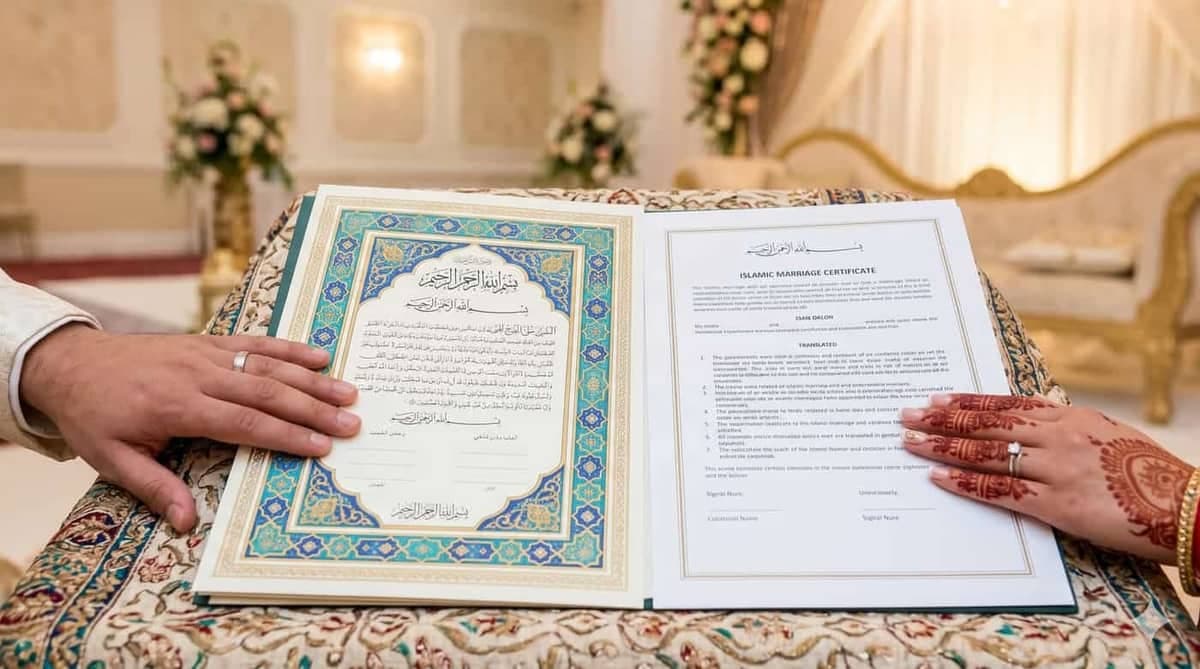
A Pakistani Nikah Nama with its certified English translation for UK visa applications
Why UK Authorities Require Certified Nikah Nama Translations
UK Visas and Immigration (UKVI) needs a certified translation for every document that is not in English or Welsh. There are no exceptions, however often caseworkers see a particular format. So a Pakistani Nikah Nama in Urdu must be translated in full, certified by the translator, and sent in with the original.
The rule covers every visa type that needs proof of marriage: spouse visas (Appendix FM), settlement (ILR), British citizenship (naturalisation) and family reunion. Courts in England and Wales also ask for certified translations when a Pakistani marriage matters in a divorce, a financial settlement, or a child custody case.
There is a practical reason too. The caseworker has to check that the marriage details — names, dates, places and conditions — match the rest of your application. An untranslated Nikah Nama tells the decision-maker nothing. A bad translation can be worse than none, because it adds errors and confusion.
Understanding the Pakistani Nikah Nama Format
The standard Pakistani Nikah Nama is a pre-printed government form with numbered columns. There are usually 20 to 25, depending on the version. The Nikah Registrar fills it in at the ceremony, normally by hand in Urdu. Both translators and applicants need to understand this layout.
Columns 1-5: Bride's Details
Full name, father's name, age, CNIC number, home address, and whether she is unmarried, divorced or widowed
Columns 6-10: Groom's Details
Full name, father's name, age, CNIC number, home address, and any earlier marriages
Columns 11-14: Mahr (Dower)
The amount of mahr muajjal (prompt dower) and mahr mu'ajjal (deferred dower), and whether it is paid in cash, gold, property or another form
Columns 15-17: Witnesses & Vakeel
The names and signatures of two male witnesses. Also the bride's vakeel (representative), if she was not there in person
Columns 18-20: Special Conditions
Any conditions either side set out. These include the wife's right of divorce (talaq-e-tafweez), limits on polygamy, or other agreed terms
Registration Details
The date of the nikah, the date of registration, the Union Council name and number, and the Nikah Registrar's name, signature and official stamp
The form also carries printed terms and conditions in Urdu, on the back or on a second sheet. These standard clauses set out legal rights under the Muslim Family Laws Ordinance 1961, such as maintenance duties and how disputes are settled. A full certified translation must include them. Many translators leave them out, and that causes trouble if the caseworker spots the gap.
Urdu to English Translation Challenges
A Pakistani Nikah Nama is much harder to translate than a normal civil document. Several things make it one of the toughest documents translators handle.
Script Direction and Layout
Urdu is written right to left, in the Nastaliq script. The Nikah Nama form is printed in Urdu, so its column headers run right to left. The English translation has to read left to right. That means the translator must rebuild the whole layout, while keeping each field linked to the right heading. Copying column by column does not work. The translation has to be laid out so an English reader can follow it easily.
Handwritten Entries
Nikah Namas are nearly always filled in by hand, and the handwriting varies a lot. Some Nikah Registrars write clearly. Others write in a way that even native Urdu speakers struggle to read. Names, addresses and CNIC numbers can be smudged, half-readable, or written over a correction. A professional translator must flag anything unclear with a note such as "[partially illegible in original]". Guessing is not allowed. UKVI wants openness, not invention.
Religious and Legal Terminology
The Nikah Nama uses religious terms from Arabic that have no exact English word. Examples are mahr muajjal (prompt dower),mahr mu'ajjal (deferred dower), ijab(proposal), qubool (acceptance), wali(guardian) and vakeel (representative). Each needs care. The best method is to give the original word in English letters and then explain it. For example: "Mahr Muajjal (prompt dower payable at the time of marriage)". That way the caseworker sees the term and understands it.
Common Translation Pitfall: Omitting the Conditions Columns
Many translators skip columns 18-20, the special conditions, when they look blank or hold only a dash. That is a mistake. A caseworker looking at a spouse visa may check whether the wife was given the right of divorce (talaq-e-tafweez), or whether any limit on polygamy was agreed. Always translate these columns in full. Where nothing was written, add "[column left blank in original]". An empty column is information too.
Name Transliteration Inconsistencies
Urdu names can be spelled in English in many ways. The name "محمد" may appear as Muhammad, Mohammed, Mohammad or Mohamed across one person's own documents. In the same way, "خدیجه" may be written Khadija, Khadijah or Khadeeja. The translator should use the passport spelling wherever possible, and note any difference. For example: "Muhammad Asif (as written in Nikah Nama; 'Mohammad Asif' in passport)." That stops the caseworker asking whether the documents are about the same person.
UKVI Spouse Visa Requirements for Nikah Nama
For a UK spouse visa under Appendix FM, a Pakistani applicant must show the marriage is legally valid, genuine and still going. The Nikah Nama is the key piece of evidence, but not the only one. Here is what UKVI usually asks for:
Registered Nikah Nama with certified English translation
The original Nikah Nama registered with the Union Council, plus a full certified translation covering every column, stamp and printed term
NADRA Marriage Certificate (computerised record)
The computerised marriage certificate from NADRA. It confirms the marriage is on the national database. Translate it too if it is in Urdu
Wedding photographs and evidence of the ceremony
Photos from the nikah ceremony, the walima reception and other wedding events help show the marriage is real
Communication evidence between spouses
Call logs, message history, video call records and photos of you together. These matter most when the couple live in different countries
Financial evidence meeting the minimum income threshold
The UK-based sponsor must meet the minimum income requirement, shown through payslips, bank statements and a letter from their employer
For a comprehensive overview of all documents needed for a spouse visa application, see our complete spouse visa document translation guide.
Nikah Nama vs NADRA Marriage Certificate
People often ask whether to translate the Nikah Nama, the NADRA marriage certificate, or both. It depends on what you have. In most cases it is best to send both.
The Nikah Nama is the original handwritten marriage contract, filled in at the nikah ceremony. It holds the full details: witnesses, mahr, conditions and both parties' signatures. It is usually a large sheet, often A3 or legal size, printed on coloured paper and carrying the Union Council's stamp.
The NADRA Marriage Certificate is a computerised document from Pakistan's National Database and Registration Authority. It takes the key facts from the Nikah Nama and sets them out in a standard layout with a unique registration number. It is printed in Urdu and English, though the English part is often incomplete or has spelling errors in the names.
Caseworkers find the NADRA certificate easier to check, because the registration number can be traced. But the Nikah Nama holds far more detail, including the conditions columns, which can matter when UKVI weighs up whether the marriage is genuine. Sending both, each with a certified translation, gives you the strongest case.
Important: NADRA Certificate Does Not Replace the Nikah Nama
The NADRA certificate confirms registration, but it does not repeat everything in the Nikah Nama. It usually leaves out the conditions columns (talaq-e-tafweez, limits on polygamy) and the detailed witness information. So if a caseworker asks for the "marriage certificate", send both documents. That leaves no doubt about what your proof of marriage is.
Union Council Registration: Why It Matters
Under Pakistan's Muslim Family Laws Ordinance 1961, every nikah must be registered with the local Union Council within a set time. The Nikah Registrar files the Nikah Nama with the Union Council and makes sure each party gets a copy. The registrar may be the imam who led the ceremony, or a separate licensed official.
Registration matters for a UK visa. An unregistered nikah may still be valid under Islamic law, but it causes real problems in a visa application. Caseworkers look for the Union Council stamp, the registration number and the Nikah Registrar's details. Those show the Pakistani state recognises the marriage in law. Without them, the caseworker may doubt that the marriage is valid.
If your Nikah Nama has no Union Council stamp or registration number, it may never have been registered properly. If so, contact the right Union Council in Pakistan and register the marriage before you apply. Late registration is possible there. You may have to attend the Union Council in person and pay a fee.
Attestation from Pakistan's Ministry of Foreign Affairs
UKVI does not ask for attestation of the Nikah Nama by Pakistan's Ministry of Foreign Affairs (MOFA). Getting it can still make your application stronger. Attestation confirms the document is genuine and comes from a recognised authority.
Attestation in Pakistan usually takes three steps. First the issuing Union Council checks the document. Then the District Commissioner or Deputy Commissioner attests it. Last, the Ministry of Foreign Affairs in Islamabad attests it. The MOFA stamp and sticker make the document valid for use abroad.
If your Nikah Nama is attested, the translator must include the attestation stamps and stickers in the certified translation. Every word on each stamp should be translated. For example: "[Rectangular stamp: Ministry of Foreign Affairs, Government of Pakistan, Attested for use abroad, Reference No. 12345/2026]."
Common Issues with Pakistani Nikah Namas
We have translated thousands of Pakistani Nikah Namas, and the same problems come up again and again. Knowing them before you apply can save you a lot of time and worry.
Incomplete or Missing Information
Some Nikah Namas have blank columns. The most common gaps are the bride's CNIC number (if she had none at the time), the conditions columns, and the mahr details. The translator should mark them "[column left blank in original]" rather than drop them. If a key field is blank, such as a name or the date of the nikah, the document may be incomplete. In that case, get a corrected version from the Union Council.
Missing CNIC numbers were common in marriages before NADRA computerised its records. If a CNIC number is missing, send the NADRA marriage certificate with the Nikah Nama to fill the gap.
Missing Signatures and Thumbprints
A valid Nikah Nama should carry the signatures or thumbprints of the bride and groom (or their vakeel), both witnesses, and the Nikah Registrar. A missing signature raises doubts about whether the marriage is valid. If a vakeel stood in for the bride, the vakeel's signature should be there, with a note saying they represented her. The translator should record whether each signature is present. For example: "[Signature of bride: present]" or "[Signature of bride: thumbprint affixed]."
Unregistered Marriages
Sometimes a marriage is never registered with the Union Council. This happens most often in rural areas, or when the nikah was informal. The Nikah Nama may then have no Union Council stamp, registration number or serial number. The marriage may still be valid under Islamic law. But UKVI will question a marriage that the Pakistani state does not officially recognise. Register it with the Union Council before you apply for the visa.
How UKVI Assesses Pakistani Marriages
Caseworkers looking at a spouse visa based on a Pakistani marriage apply a two-part test. First, is the marriage legally valid under Pakistani law? Second, is the relationship genuine and subsisting?
Legal Validity
For a Pakistani Muslim marriage to be legally valid, four things must be true. Both parties (or their vakeel) consented. Witnesses were present. A mahr was set. And the marriage was registered with the Union Council. The Nikah Nama is the main proof of all four. If the caseworker spots something wrong — a missing Union Council stamp, dates that do not match, or a bride below the legal marriage age — they may doubt the marriage or ask for more evidence.
Genuine Relationship Test
Even a legally valid marriage must convince UKVI that it is not a "marriage of convenience" arranged mainly to get a visa. Caseworkers look at all the evidence together: how the couple met, how long they were together before the wedding, proof of contact and visits, whether the marriage fits the community's usual customs, and whether both partners give matching answers about each other's lives.
Arranged marriages are not treated as suspect. UKVI guidance says plainly that they are a normal cultural practice in many communities. The caseworker will still want proof that both partners agreed freely, and that a real relationship has grown, even though the families made the introduction. The conditions columns of the Nikah Nama can help here. Conditions that protect the wife's rights, such as talaq-e-tafweez, suggest the marriage was thought through, not rushed.
Strengthening Your Application
A well-translated Nikah Nama shows the caseworker you have nothing to hide. That means every column accounted for, name spellings checked against passports, stamps described in full, and anything odd noted openly. Add the NADRA marriage certificate, wedding photos and full evidence of contact, and you have the strongest possible spouse visa application.
What a Complete Nikah Nama Translation Must Include
For UKVI, a certified translation of a Pakistani Nikah Nama must be complete and open about anything unclear. Our translators follow a strict checklist:
All numbered columns translated
Every column on the form, including blank ones, with the column numbers kept so they are easy to cross-check
Religious terms transliterated and explained
Arabic and Urdu terms written in English letters, with the meaning in brackets
Names matched to passport spellings
Every name spelled the same way throughout, with a note wherever the Nikah Nama spelling differs from the passport
Stamps and seals described
The Union Council stamp, the Nikah Registrar's stamp and any MOFA attestation stamps, all translated and described
Signatures and thumbprints noted
A clear note saying whether each required signature is there or missing
Translator's certification statement
A signed statement confirming the translation is accurate and complete, with the translator's qualifications and contact details
For more information on what UKVI expects from certified translations generally, see our religious marriage certificate translation guide which covers the broader requirements for all faith traditions.
Frequently Asked Questions
How long does it take to translate a Pakistani Nikah Nama?
A standard Nikah Nama translation usually takes 24 to 48 hours. It can take a little longer if the handwriting is very hard to read, or the document has extra pages, several attestation stamps, or damaged parts. Order the translation at least two weeks before you submit your visa application. That leaves time to review it and fix anything that needs fixing.
Do I need to translate both the Nikah Nama and the NADRA marriage certificate?
We strongly advise translating both. The Nikah Nama holds the full detail of the marriage contract. The NADRA certificate gives a registration number that can be checked. Together they are the fullest proof of marriage. If the NADRA certificate has English next to the Urdu, only the Urdu parts need translating. A full translation, though, leaves no doubt that nothing was missed.
My Nikah Nama has no Union Council stamp. Can I still use it?
A Nikah Nama with no Union Council stamp suggests the marriage was never formally registered. It may still be valid under Islamic law. But UKVI expects a marriage to be legally recognised in the country where it took place. Contact the right Union Council in Pakistan and register it. Late registration is usually possible if you have supporting evidence. Once it is registered, you get a stamped Nikah Nama, and you can then apply for the NADRA marriage certificate.
The names on my Nikah Nama are spelled differently from my passport. Is this a problem?
Name spellings very often differ between Urdu and English documents, and caseworkers know this. Even so, the translation must deal with the difference. A professional translator writes the name as it appears in the Nikah Nama and adds a note such as "[Name appears as 'Mohammad Asif' in passport]." That stops the caseworker asking whether the documents are about the same person.
Can I get my Nikah Nama translated by a family member or community member?
UKVI does not keep a list of approved translators, so in theory anyone can certify a translation. But if a family member or friend does it, they have a personal interest in the outcome. Caseworkers may treat such a translation with doubt, especially in a spouse visa where they are testing whether the marriage is genuine. An independent professional service removes that risk completely.
Is the mahr amount relevant to my UK visa application?
The mahr (dower) amount is not a visa requirement, and it does not decide your application. It must still be translated accurately as part of the full Nikah Nama. Leaving the mahr columns out, or turning "to be decided later" into a blank, makes the translator look careless. Now and then a very high or very small mahr catches a caseworker's eye when they test whether the marriage is genuine. On its own, though, it would not decide the outcome.
Translate Your Pakistani Nikah Nama Today
Our certified translators specialise in Pakistani Nikah Namas. They know the Urdu legal terms and they know what UKVI caseworkers look for. Upload your document and get a UKVI-ready certified translation, usually within 24 hours.
Get Your Certified TranslationRelated Articles
Religious Marriage Certificate Translation
Complete guide to translating Nikah Namas, Ketubot, and other religious marriage certificates for UKVI.
Spouse Visa Translation Documents
Everything you need translated for a UK spouse visa application, from marriage certificates to financial evidence.
Marriage Certificate Translation for UK Visa
Requirements and costs for translating civil marriage certificates for all UK family visa categories.
Related Services
Urdu Document Translation
Certified Urdu to English translation for Pakistani documents including Nikah Namas, birth certificates, and academic records.
Arabic Document Translation
Certified Arabic document translation for marriage contracts and legal documents.
Spouse Visa Translation Services
Complete translation service for all UK spouse visa supporting documents.
Marriage Certificate Translation
Professional certified translation of marriage certificates for UKVI applications.
Continue Reading
Religious Marriage Certificate Translation for UK Visa
UKVI guidance on translating Nikah Namas, Ketubot, and other religious marriage certificates.
Spouse Visa Translation Documents: Complete Guide
Full list of documents requiring certified translation for UK spouse visa applications.
Marriage Certificate Translation for UK Visa
Requirements, costs, and timelines for translating marriage certificates for UKVI applications.
Urdu Document Translation for UK Visa
Certified Urdu to English translation for all UK visa document types.