
Death Certificate Translation for UK Visa, Probate & Legal Use
When a loved one dies abroad, you may need a certified English translation of their death certificate. UK visa applications, probate, inheritance claims and pension claims all ask for one. This guide covers every situation where you will need a translation — handled with the care and discretion these documents deserve.
A Note on Sensitivity
We know that people often arrange these translations at a very hard and tiring time. Our professional translators handle these documents with great care and discretion. If you need an urgent translation to attend a funeral abroad, or to deal with urgent legal matters, please contact us — we put bereavement cases first.
When Do You Need a Death Certificate Translation?
A death certificate issued outside the United Kingdom needs a certified death certificate translation into English before you can use it for any official purpose in the UK. More situations need a certified translation than most people expect. Getting the right translation at the start prevents delays at an already stressful time.
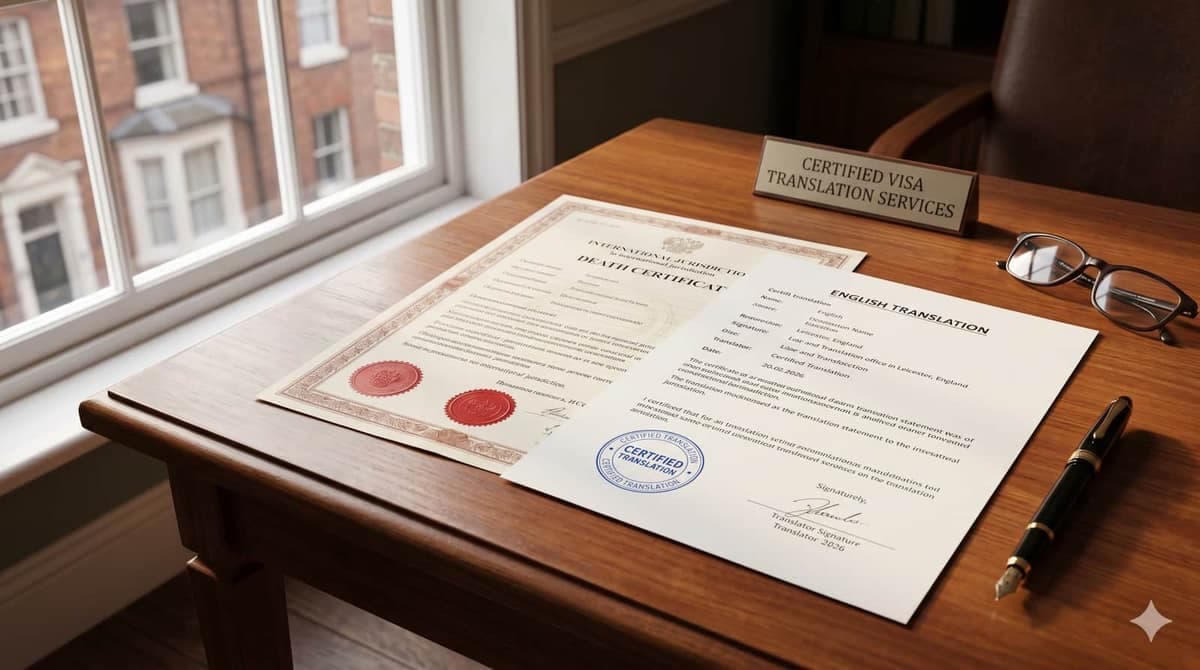
A certified death certificate translation alongside the original document
| Purpose | Translation Required? | Notes |
|---|---|---|
| UK Visa Application (widowed status) | Required | UKVI certified translation essential |
| ILR — sponsor has died | Required | Proves sponsor relationship ended by death |
| Grant of Probate (UK courts) | Required | For foreign estates passing through UK courts |
| Inheritance & estate claims | Required | Banks and solicitors require certified copy |
| Pension claims | Required | UK pension providers and DWP |
| Life insurance claims | Required | UK insurers need certified English translation |
| Remarriage (after bereavement) | Required | Registrar requires proof of previous partner's death |
| Foreign property claims | Required | UK solicitors handling overseas estate |
| Bereavement visa (attending funeral) | Sometimes Required | Depends on country — urgent service available |
| UK State Pension bereavement benefit | Required | DWP bereavement support payment claims |
UKVI Scenarios: Visa Applications Involving a Death Certificate
Visa guidance rarely mentions death certificates, but the Home Office asks for them in several important cases. Getting the translation right matters, because these applications often carry great personal and financial weight.
Applying as a Widowed Partner (Spouse Visa / ILR)
If you were married to a British citizen or settled person who has died, you may still be able to apply for leave to remain or Indefinite Leave to Remain as a bereaved partner. Under Appendix FM of the Immigration Rules, a bereaved partner can apply if the relationship was genuine and subsisting when their partner died.
Here, the death certificate of your UK-settled partner is key evidence. If it was issued outside the UK, you must provide a certified English translation. The translation must clearly show:
- The deceased's full legal name (matching your relationship documents)
- Date and place of death
- That the cause was natural, accidental, or otherwise — not relevant to immigration status but caseworkers read it
- The registration authority and certificate number for verification
Important: Name Must Match Relationship Documents
UKVI will check the name on the death certificate against your marriage certificate and any past visa grant letters. Names sometimes differ because they were spelled out from another script in different ways. If that happens, include a translator's note that explains the difference. This is very common with Arabic, Chinese, Hindi and Russian names.
Proving a Relationship Ended by Death (Not Divorce)
When you apply for a new spouse or partner visa after an earlier marriage, you must show that the earlier relationship legally ended. If your former spouse or civil partner died, the right document is a certified translation of their death certificate — not a divorce decree. This matters because countries treat the end of a marriage by death in different ways. UKVI caseworkers need the English translation to confirm the facts on record.
ILR Applications Where the Sponsor Has Died
You may be living in the UK on a family visa when your British or settled sponsor dies before you reach the five-year point for ILR. Rules exist that may still let you stay in the UK. On the bereaved partner route, a certified translation of your sponsor's death certificate (if it was issued abroad) is core evidence. You send it with your marriage certificate, relationship evidence and accommodation details.
Probate and Inheritance: Using Translated Death Certificates in UK Courts
Probate in England and Wales needs proof of death before the court can issue a Grant of Probate or Letters of Administration. If the person died outside the UK, the foreign death certificate must be translated before you send it to the Probate Registry.
What the Probate Registry Requires
- Certified English translation of the foreign death certificate
- Translator's declaration confirming accuracy and the translator's qualifications
- The original foreign death certificate (or a notarised copy)
- Apostille on the death certificate if required by the country of issue (see below)
Foreign Property Claims
A UK resident may die abroad and leave property in that country. The UK solicitors who handle the estate will normally need a certified English translation of the death certificate before they can advise. The same applies the other way round. If someone from another country dies and leaves UK property, the foreign death certificate must be translated before UK banks, land registries and courts can deal with the estate.
Bank Accounts and Financial Institutions
UK banks and building societies will not release money from a deceased person's account without proof of death. If the certificate came from abroad, you need a certified English translation. Most big UK banks (Barclays, HSBC, NatWest, Lloyds) say clearly that they need certified translations. They will reject an uncertified Google Translate printout.
Country-Specific Death Certificate Formats
Death certificates differ a lot from country to country. The language changes, and so does the information they hold, the way they are laid out, and what makes them legally valid. Here is a guide to the most common origin countries for UK visa applicants and probate proceedings.
| Country | Language(s) | Key Features | Common Challenges |
|---|---|---|---|
| India | Hindi, regional languages, or bilingual | Municipal/Panchayat issue; CRS computerised format since 2010s | Older certificates handwritten; cause of death may use local medical terminology |
| Pakistan | Urdu | NADRA death registration form; Union Council format in rural areas | Stamps and endorsements often in Urdu only; date format may use Islamic calendar |
| China | Simplified Chinese | Must be notarised by Chinese notary before use abroad; hospital death certificate separate from civil registration | Two-document system (hospital + civil); name transliteration to Pinyin critical |
| Nigeria | English (with Yoruba/Igbo/Hausa annotations) | National Population Commission (NPC) certificate; LGA certificates also issued | LGA certificates may be partially in local languages; authentication chain required |
| Poland | Polish | Odpis aktu zgonu (death record extract); issued by USC (civil registry office) | Diacritical marks (ą, ę, ś, etc.) must be preserved; cause of death uses ICD codes |
| Turkey | Turkish | Ölüm belgesi; issued by municipal civil registry (Nüfus Müdürlüğü) | Ottoman script on older historical certificates; cause of death in Turkish medical terminology |
| Arabic Countries (Egypt, Jordan, Morocco, Iraq, Syria, Lebanon) | Arabic (Modern Standard or dialect) | Varies by country; religious affiliation often recorded alongside civil registration | Islamic calendar dates alongside Gregorian; religious death rites noted; right-to-left script requires specialist translator |
| Philippines | Filipino (Tagalog) and English | PSA (Philippine Statistics Authority) Certificate of Death; barangay and municipal formats | Cause of death may appear in abbreviated medical form; certificates issued years after death are common |
| Bangladesh | Bengali | Union Parishad or City Corporation certificates; BDRIS system for newer certificates | Registration delays common; older certificates may use handwritten Bengali; Islamic calendar dates |
| Romania | Romanian | Certificat de deces; issued by local Starea Civilă office | Cause of death in Romanian medical terminology; apostille from Ministry of Justice required |
Translation Challenges Unique to Death Certificates
Death certificates raise translation problems that other civil documents do not. Knowing about them helps you see what a professional translator has to deal with.
Medical Cause of Death Terminology
The cause of death section is often written in medical Latin, local medical terms, or very short clinical wording. Terms like "myocardial infarction," "cerebrovascular accident," or "septicaemia" may appear in the local language. They may also appear as short ICD (International Classification of Diseases) codes. You need a professional translator who knows medical terms to get these right. A wrong translation of the cause of death can cause trouble in insurance claims and estate cases.
Religious and Cultural Death Customs
In many countries, death certificates record religion and how the body was prepared for burial under religious custom. An Islamic certificate may note that the person was buried according to Islamic rites. A Hindu certificate may mention cremation under a set tradition. These notes must be translated accurately. They matter most when the certificate is used for a remarriage, where religious law can play a part.
Pakistani and Bangladeshi death certificates may give the time of death in the Islamic (Hijri) calendar as well as the Gregorian date. A good translator converts these and shows both dating systems in the translation.
Multiple Death Registration Systems
Some countries run more than one death registration system side by side. In India, for example, a death can be registered by the municipal corporation, by the state through the civil registration system, and in some states through a hospital authority. The document you get depends on which system was used. In China, the hospital death certificate (医学死亡证明书) is separate from the civil registration death certificate (居民死亡医学证明). Only the civil registration version carries legal weight for UK probate.
Which Document Should You Translate?
You may have several documents about the death (a hospital notice, a civil registration certificate, a religious certificate). Always translate the civil registration certificate — the one issued by the government's civil registry authority. This is the document that UK courts and UKVI accept. If you are not sure which document you have, contact us and we will advise.
Apostille Requirements: When Translation Alone Is Not Enough
For some UK purposes, a certified translation on its own is enough. For others — above all probate and use in court — the original foreign death certificate may also need an apostille before you translate and use it. An apostille is an international stamp issued under the Hague Convention (1961). It confirms that the document is genuine.
| Purpose | Translation Required? | Apostille Required? | Notes |
|---|---|---|---|
| UKVI Visa Application | Yes | Usually No | UKVI rarely requires apostille; certified translation sufficient |
| UK Probate Registry | Yes | Sometimes | Depends on country of issue and the solicitor's requirements |
| UK Court Proceedings | Yes | Often Yes | Foreign documents used as court evidence typically require apostille |
| UK Pension / DWP Claim | Yes | Rarely | DWP typically accepts certified translation without apostille |
| UK Bank / Financial Institution | Yes | Rarely | Banks set their own requirements — check with your specific bank |
| Remarriage (Register Office) | Yes | Sometimes | Local register office may request apostille for non-Hague countries |
Countries that have not signed the Hague Convention (including some in Africa and the Middle East) cannot issue apostilles. There, the country's Foreign Ministry must authenticate the document. The UK Embassy or High Commission in that country then legalises it. This is called consular legalisation, and it takes longer than an apostille. See our guide on apostille versus certified translation for a full explanation.
Bereavement Visa: Urgent Translations for Attending Funerals Abroad
Time is short if you are in the UK and must travel abroad for a funeral, or if a family member abroad must come to the UK for one. The UK has no special "bereavement visa" category. But a standard visitor visa application can sometimes be handled urgently, and a translated record of the death can support it.
If you are a foreign national already in the UK and need to travel abroad and come back, the main question is whether your current leave lets you re-enter. If someone is coming to the UK for a funeral, a translated death certificate of the UK-resident person who died can support their visitor visa application and show the purpose of the visit.
Urgent Bereavement Translation Service
We offer same-day and next-day translation for bereavement documents. If you need a death certificate translated urgently for a visa or to attend a funeral, contact us directly. We will put your order first.
- • Same-day translation available (4-6 hour turnaround)
- • Digital delivery — no need to wait for postal copies
- • UKVI-certified format accepted by the Home Office
Common Issues with Death Certificates
Certificates Issued Years After the Death
In some countries — above all in South Asia, West Africa and parts of the Middle East — death certificates are often issued long after the death, sometimes years or even decades later. This usually happens when a death in a rural area was not registered at the time. It also happens when a family only needs the certificate later for legal or immigration reasons. These "delayed registration" certificates are valid, but they may carry a note about the late registration. A professional translator will include that note. Never ask for it to be left out, because leaving it out is document fraud.
Amended Certificates
Sometimes a death certificate is changed after the first registration to fix an error — a misspelled name, a wrong date, or a revised cause of death. Amended certificates usually carry notes, corrections or stamps that show the change and the date of the change. All of these must be translated in full. If your translation leaves out the amendment note, a caseworker may question the document's accuracy.
Certificates with Partial Information
In some countries, a death certificate may leave out details that a UK one would always show. It may list no cause of death, which is common for deaths in conflict zones or remote areas. It may record only part of a name. Translators cannot add information that is not in the original document. Where something is missing, the translation says so with a phrase such as "[not stated in original document]" — and this is the correct approach.
Do Not Request an "Improved" Translation
Some people ask translators to leave out awkward information or to "improve" the document in translation. This is document fraud. It can lead to a visa refusal, deportation, or criminal prosecution. A certified translation must be a true and complete copy of the original document — including its gaps and any details you would rather hide.
What the Certified Translation Must Include
UKVI-Compliant Death Certificate Translation Checklist
- Full name of the deceased (with transliteration note if applicable)
- Date and place of death (with calendar conversion note if Islamic or other calendar used)
- Cause of death (accurately translated, including medical terminology)
- Names of surviving relatives (where listed on the certificate)
- Registration number and date of registration
- Issuing authority name and official stamps (described)
- Religious notations, if any, accurately rendered
- Any margin annotations, amendments, or corrections translated in full
- Translator's signed declaration of accuracy, with name, qualifications, and date
Step-by-Step Process
Obtain the Official Death Certificate
Make sure you have the civil registration death certificate — not just a hospital notice or religious certificate. This is the one issued by the government registry.
Check Apostille Requirements
Before you order the translation, check whether your purpose needs an apostille. UKVI applications usually do not need one. For UK court use or probate, ask your solicitor.
Scan All Pages and Annotations
Scan at 300 DPI in colour. Include front and back. Make sure all stamps, handwritten annotations, and margin notes are clearly visible. Blurry or cropped scans cause delays.
Upload for Professional Translation
Send your document to a certified translation service. Tell them the purpose (visa, probate, insurance) and any passport name spellings the translation should match.
Review the Translation Carefully
Check that the deceased's name matches the other documents in your bundle. Check that all dates are correct and that the cause of death is translated accurately.
Submit with Supporting Documents
For visa applications, submit alongside your marriage certificate (translated if needed) and other relationship evidence. For probate, submit with the will and other estate documents.
Costs and Turnaround Times
| Service Level | Turnaround | Starting Price | Suitable For |
|---|---|---|---|
| Standard Translation | 24 hours | From £17.99/page | Probate, inheritance, pension claims |
| Rush Translation | 8 hours | From £29.99/page | Visa applications, bank claims |
| Same-Day / Bereavement Urgent | 4-6 hours | From £29.99/page | Urgent visa purposes, funeral travel |
Most death certificates are 1-2 pages. The cause of death section can take extra time when it uses a lot of medical terms. All prices include the translator's signed certification declaration.
Frequently Asked Questions
Does UKVI require the cause of death to be translated, or can that section be redacted?
UKVI needs a complete and faithful translation of the whole document, including the cause of death. If you black out or leave out any section, the translation does not meet the rules. That can lead to a refusal or to a claim that you tried to deceive. We know this is sensitive information, but a certified translation must show the full original document. Our translators handle it with complete discretion and confidentiality.
Can I use a death certificate translation from several years ago, or does it need to be recent?
Death certificates do not expire, because the facts cannot change. So a certified translation does not need to be redone if it was correct the first time. That said, if you are submitting to UKVI or the courts, some authorities prefer a translation dated within the past 12 months. If a professional service did your translation and it carries the required certification, it is likely still acceptable. Check the rules of the body you are sending it to.
The death certificate is in Arabic and records an Islamic calendar date. How is that handled?
A professional Arabic translator who works with official documents converts the Hijri (Islamic) date to the Gregorian date and shows both in the translation. For example: "14 Ramadan 1445 AH (24 March 2024 CE)." This is standard practice and makes the date clear for UK authorities. Do not convert the date yourself. A mistake in a date on an official document can cause serious problems.
The death occurred in a country that has no apostille treaty with the UK. What do I do?
For countries outside the Hague Apostille Convention — such as some in South Asia and sub-Saharan Africa — the other route is consular legalisation. That country's Foreign Ministry authenticates the death certificate. The British Embassy or High Commission there then legalises it. You can then have the legalised certificate translated. This can take several weeks, so plan ahead. For UKVI alone, an apostille or legalisation is often not required. A certified translation of the original is usually enough.
Do I need to translate the death certificate if my deceased partner was British?
If your British partner died in the UK, their death certificate is in English and needs no translation. If they died abroad — even as a British citizen — the country where they died issues the certificate, in that country's language. In that case, yes, you need a certified English translation for UK legal and immigration purposes. British embassies and consulates can issue a local death report as an extra document, but the host country's civil registration certificate is the main one.
Related Document Guides
- Birth Certificate Translation for UK Visa — country formats and UKVI requirements
- Marriage Certificate Translation for UK Visa — for spouse and partner visa applications
- UK Visa Document Checklist 2026 — complete list of documents required for each visa category
- Apostille vs Certified Translation — when you need one or both
Related Services
Continue Reading
Marriage Certificate Translation for UK Visa
Complete guide to translating marriage certificates for UKVI
UK Visa Document Checklist 2026
Every document you need for each UK visa category
Apostille vs Certified Translation
When you need an apostille, when translation alone is enough
Get Your Death Certificate Translated
UKVI-certified translation from £17.99/page. We handle bereavement documents with discretion and care — same-day service available for urgent cases.
Trusted by thousands of visa applicants • UKVI certified • Urgent bereavement service available
Related Articles
Birth Certificate Translation for UK Visa
Country formats, UKVI requirements, and name discrepancy guidance.
Marriage Certificate Translation for UK Visa
Everything you need to translate your marriage certificate for UKVI.
UK Visa Document Checklist 2026
Complete checklist of every document required for each UK visa category.