
The Certified Translation Process Explained — Step by Step
From uploading your document to receiving a UKVI-compliant certified translation — here's exactly what happens at each stage and what you should expect.
If you need a certified translation for a UK visa application, it helps to understand the process from start to finish. You can prepare your documents correctly, know what turnaround to expect, and avoid costly delays. Whether it's a birth certificate, marriage certificate, or academic transcript, the process follows the same core steps.
This guide walks through every stage of the certified translation process — from sending in your source document to receiving a signed and stamped, UKVI-compliant certified translation ready for your visa application.
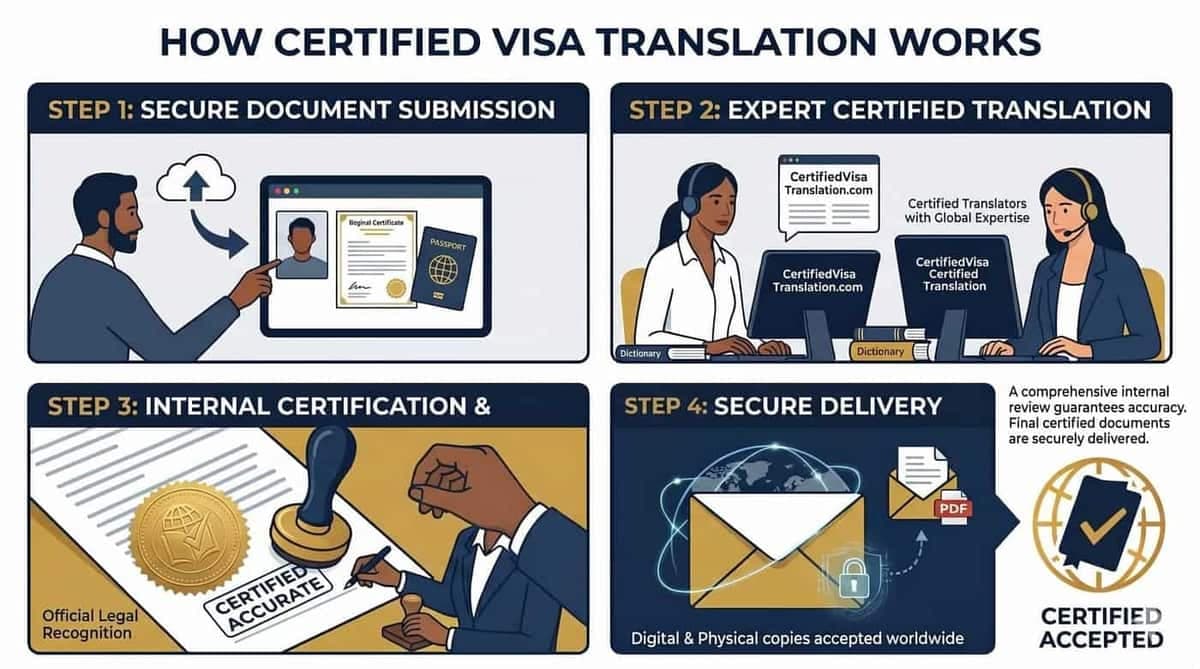
The four-step certified translation process for UK visa documents
Overview: The Four Stages
Every certified translation follows four core stages. This is true for any document type, language pair, or translation provider. Knowing these stages helps you plan your visa application timeline.
1. Document Submission
Upload or send your original document in a supported format
2. Translation
Professional translation with quality assurance review
3. Certification
Formal certification statement with translator credentials
4. Delivery
Signed and stamped PDF delivered via email, ready for submission
Step 1: Document Submission
The process begins when you submit your original document for translation. The quality of your upload directly affects the quality and speed of the translation. So it's worth taking a moment to get this right.
Accepted Formats
Most professional translation services accept documents in the following formats:
PDF files — the preferred format for maintaining document layout and quality
High-resolution scans (300 DPI or higher) — clear, legible text is essential
Photograph images (JPEG, PNG) — acceptable when scans are not possible, but quality matters
Word documents (DOCX) — for text-based documents without complex formatting
Multi-page documents — all pages should be included in a single file where possible
Photo vs Scan Quality
Smartphone photos are accepted, but scanned documents give much better results. If you must use a photo, make sure the document is flat and evenly lit with no shadows. All text — including stamps, seals, and handwritten sections — must be clearly visible.
Common Submission Mistakes to Avoid
- Cropped images that cut off document edges, stamps, or seals
- Blurry photos where text is not fully legible
- Missing pages from multi-page documents
- Password-protected PDFs that cannot be opened by the translator
- Extremely low-resolution images (below 150 DPI)
Multi-Page Documents
For multi-page documents like academic transcripts, court orders, or financial statements, submit all pages together in a single file. Each page will be translated and included in the certified output. The translator needs the complete document to produce an accurate, certifiable translation. Partial documents cannot get proper certification.
Step 2: Translation
Once your document arrives, the translation stage begins. This is where the source text is turned into English (or the target language) while keeping its meaning, context, and structure.
How Professional Translators Work
Professional translators follow a structured approach. First they review the whole document to understand the context. They spot technical terms and note anything that needs special care — such as official stamps, handwritten notes, or legal phrasing specific to the source country.
The translation must be complete and accurate. Every part of the original document is translated. This includes headers, footers, stamps, seals (described in text), signatures (noted), and any notes in the margins. Nothing is left out.
Translation and Line-by-Line Review
A qualified translator produces the translation and is responsible for every line of it. Free machine tools are not a substitute (see why immigration authorities reject machine translation), because nobody can sign a declaration for their output.
What the Translator Checks
Before the translation is certified, the translator:
- Verifies accuracy against the original document, line by line
- Corrects any mistranslations, particularly with legal or technical terms
- Ensures proper handling of names, dates, addresses, and official titles
- Adjusts formatting and layout to match the original document structure
Quality Assurance During Translation
Before the translation moves to the certification stage, it goes through a quality review. This includes checking spelling and grammar, checking that all names, dates, and numbers match the original, and confirming the formatting is consistent and professional. Any problems are fixed before the translation is approved for certification.
Step 3: Certification
Certification is what transforms an ordinary translation into an officially accepted document. It is the stage that gives the translation its legal standing and makes it acceptable to UKVI and other authorities.
What the Certification Statement Includes
A proper certified translation must include a certification page containing all of the following elements:
Required Certification Elements
- Translator's declaration — A formal statement confirming the translation is a true, complete, and accurate representation of the original document
- Translator's full name — The individual who completed or verified the translation
- Professional credentials — Qualifications, memberships (ITI, CIOL), degrees, or relevant experience
- Translator's signature — Physical or digital signature authenticating the declaration
- Contact details — Business address, email, and phone number for verification
- Date of certification — The date the certification was issued
- Document identification — Description of the original document being translated (type, language, issuing authority)
Example Certification Statement
"I, [Translator Name], a qualified translator, hereby certify that the attached translation from [Source Language] into English is a true and accurate translation of the original document. I am competent to translate from [Source Language] into English and have the qualifications and experience necessary to provide this certification."
Translator: [Full Name]
Qualifications: [e.g., MA Translation Studies, MCIL, ITI Member]
Contact: [Company Address, Email, Phone]
Signature: _______________
Date: [DD/MM/YYYY]
Certificate Number: [Unique Reference]
The Certified Document Package
The final certified translation is assembled as a complete package containing three components in order: the certification page, a copy of the original source document, and the translated document. These are bound together as a single PDF so the three parts always stay together. This structure is what UKVI caseworkers expect to see when reviewing translated documents.
Step 4: Delivery
The final stage is delivering the completed certified translation to you in a format ready for submission with your visa application.
Digital Delivery (Signed and Stamped PDF)
The standard delivery method is a signed and stamped PDF sent via email. This is the most common and fastest option. The PDF contains the complete certified translation package — certification page, original document copy, and translation. The certification statement is signed, and every translated page carries a stamp with the signer, certificate number and date.
UKVI fully accepts digital certified translations. Since most visa applications are now submitted online through the GOV.UK portal, a digital PDF is the most practical format. You simply upload the PDF alongside your other application documents.
Physical Copies
Some applicants prefer or require physical copies — for example, when attending an in-person appointment at a visa application centre. Most translation services can arrange printed copies sent by post, though this adds to the turnaround time. The digital version is equally valid, so physical copies are a matter of convenience rather than necessity.
Turnaround Times
| Document Type | Standard | Rush |
|---|---|---|
| Birth / Marriage Certificate | 24 hours | Same day |
| Academic Transcript (1-3 pages) | 24-48 hours | Same day |
| Bank Statements (multiple pages) | 48-72 hours | 24 hours |
| Legal / Court Documents | 48-72 hours | 24 hours |
| Complex / Lengthy Documents (10+ pages) | 3-5 business days | 48 hours |
For urgent needs, see our rush translation guide for same-day and express options.
What Happens After You Receive Your Translation
Once you have your certified translation, the next step is submitting it with your visa application. Here is what you need to know:
Upload the certified translation PDF alongside the original document when submitting your visa application online
Keep the original document and certified translation together — UKVI caseworkers review both side by side
Do not alter or edit the certified PDF in any way — upload it exactly as you received it
Save a backup copy of the certified translation for your records
If submitting physical documents, include both the certified translation and a copy of the original
How Long Is a Certified Translation Valid?
UKVI does not impose a specific expiration date on certified translations. However, the translation should reflect the current version of the document. If the original document has been updated or reissued since the translation was completed, you may need a new translation. As a practical guideline, translations less than six months old are unlikely to be questioned.
Quality Assurance Process
A robust quality assurance process is what separates professional certified translation services from unreliable providers. Here is what a thorough QA process includes:
Proofreading
Every translation is proofread by a second pair of eyes — either a senior translator or a dedicated proofreader. They check for spelling errors, grammatical mistakes, and inconsistencies in terminology. This step catches errors that the original translator may have missed.
Formatting Checks
The translated document should mirror the structure and layout of the original as closely as possible. QA checks verify that tables, columns, headers, and other formatting elements are correctly reproduced. For documents like academic transcripts or bank statements, maintaining the original layout is particularly important.
Certification Verification
Before delivery, the certification page itself is reviewed to ensure all required elements are present and accurate. This includes verifying the translator's name, credentials, contact details, the declaration text, the date, and the document reference. An incomplete certification page could lead to a UKVI rejection.
What Makes the PDF Official
A certified translation PDF is official because of what it contains, not because of special software. UKVI caseworkers look for clear certification details they can read on the page.
What Every Certified PDF Includes
- Signed certification statement — Confirms the translation is true and accurate, signed by the authorised representative or translator
- Company stamp on every translated page — A Certificate of Accuracy stamp showing the signer, certificate number and date
- Unique certificate number — Links every page of the translation to one certification
- Original document attached — Caseworkers can compare the source and the translation side by side
Upload tip: the PDF is a standard file with no password, encryption or digital-signature lock. Upload it to the UKVI or visa application centre portal exactly as you receive it. There's no need to print and re-scan it.
Common Questions About the Process
Do I need to send original documents by post?
No. For certified translation purposes, a clear scan or high-quality photo of your document is sufficient. You should keep your original documents safe and never post them unless specifically requested by UKVI. The translation is produced from the digital copy you provide.
Can I get a certified translation of a document that is already in English?
If your document is entirely in English, it does not need translation. However, if it contains elements in another language — such as stamps, annotations, or sections of text — those parts may need certified translation. Some documents issued in bilingual countries may have mixed-language content that requires partial translation.
What if my document is handwritten?
Handwritten documents can be translated, but they may require additional time. The translator needs to decipher the handwriting accurately, which can be challenging with certain scripts or writing styles. Providing the clearest possible scan helps significantly. If certain words are illegible, the translator will note this in the translation.
How Our Process Differs
At CertifiedVisaTranslation.com, we have built our process around three priorities: speed, accuracy, and competitive pricing. Here is how our approach compares to traditional translation agencies:
Our Approach
- Instant quote — upload and get pricing in seconds
- Professional translators, with every page checked before certification
- Faster turnaround than traditional agencies
- Signed and stamped PDFs, ready to upload
- Transparent per-page pricing, no hidden fees
Traditional Agencies
- Email back-and-forth for quotes (24-48 hour wait)
- Manual-only translation process
- 3-5 business day standard turnaround
- Physical stamps and posted copies
- Variable pricing with additional fees for rush
For a detailed comparison of how to evaluate translation providers, see our guide on how to choose a translation service in the UK.
What to Do If UKVI Queries Your Translation
In rare cases, a UKVI caseworker may query a certified translation. This could happen if the certification is incomplete, if the translator's credentials are unclear, or if there is a concern about accuracy. Here is how to handle it:
If Your Translation Is Queried
- Contact your translation provider immediately — A reputable provider will help resolve the query at no extra cost
- Provide additional documentation — The translator can supply a letter confirming their credentials and the translation's accuracy
- Request a revised certification — If the issue is with the certification statement, the provider can issue an updated version
- Consider a second translation — If the accuracy is questioned, getting a second independent translation can support your case
Queries are uncommon with professionally certified translations. The best way to avoid them is to use a provider who includes all required certification elements and delivers translations that meet UKVI standards from the outset.
Frequently Asked Questions
How long does the entire certified translation process take?
For standard documents like birth or marriage certificates, the entire process — from submission to delivery — typically takes 24 hours. More complex documents such as lengthy legal papers or academic transcripts may take 2-5 business days. Same-day service is available for urgent requests. The process is fastest when you submit a clear, complete scan of your document.
Is a digital certified translation accepted by UKVI?
Yes. UKVI fully accepts digital certified translations in PDF format. Since most visa applications are submitted online, digital PDFs are the standard format. Our PDFs have no password or lock, so you can upload them straight to the portal.
What is the difference between a certified translation and a notarised translation?
A certified translation includes a translator's declaration of accuracy — this is what UKVI requires. A notarised translation has been additionally witnessed by a notary public, which is not required by UKVI but may be needed for some legal proceedings. For UK visa applications, a standard certified translation is sufficient.
Can I use the same certified translation for multiple visa applications?
Yes, provided the original document has not changed. A certified translation of your birth certificate, for example, can be used for multiple applications over time. There is no rule that requires a new translation for each application. However, if the original document has been updated or reissued, you will need a new translation of the current version.
How much does a certified translation cost in the UK?
Certified translation costs typically range from £15 to £30 per page, depending on the language pair and document complexity. Simple documents like birth certificates (usually 1 page) are at the lower end. For a detailed pricing breakdown, see our certified translation cost guide.
Related Services
Continue Reading
What Is a Certified Translation?
Complete definition, requirements, and how to verify authenticity
How to Choose a Translation Service in the UK
Key factors to evaluate when selecting a certified translation provider
AI vs Human Translation for Visa Documents
Why machine translation is rejected for visa documents
Certified Translation Costs in the UK
Complete pricing breakdown for certified translations in 2026
Ready to Start Your Certified Translation?
Upload your document, get an instant quote, and receive a UKVI-compliant, signed and stamped certified translation.