
AI Translation vs Human Translation for Visa Applications: Why ChatGPT Won't Work
Free tools like ChatGPT, Google Translate, and DeepL are impressive. But they cannot make a certified translation that UKVI, USCIS, or IRCC will accept. Here is why, and what a valid certified translation involves.
The Temptation Is Real
You have a birth certificate in Polish, a marriage document in Arabic, or a bank statement in Mandarin. You need it translated for a visa application. Then it hits you: ChatGPT is free. Google Translate is free. DeepL is free and probably better. You paste in the text and get smooth English back in seconds. So why would anyone pay £20–£30 per page for a human translator?
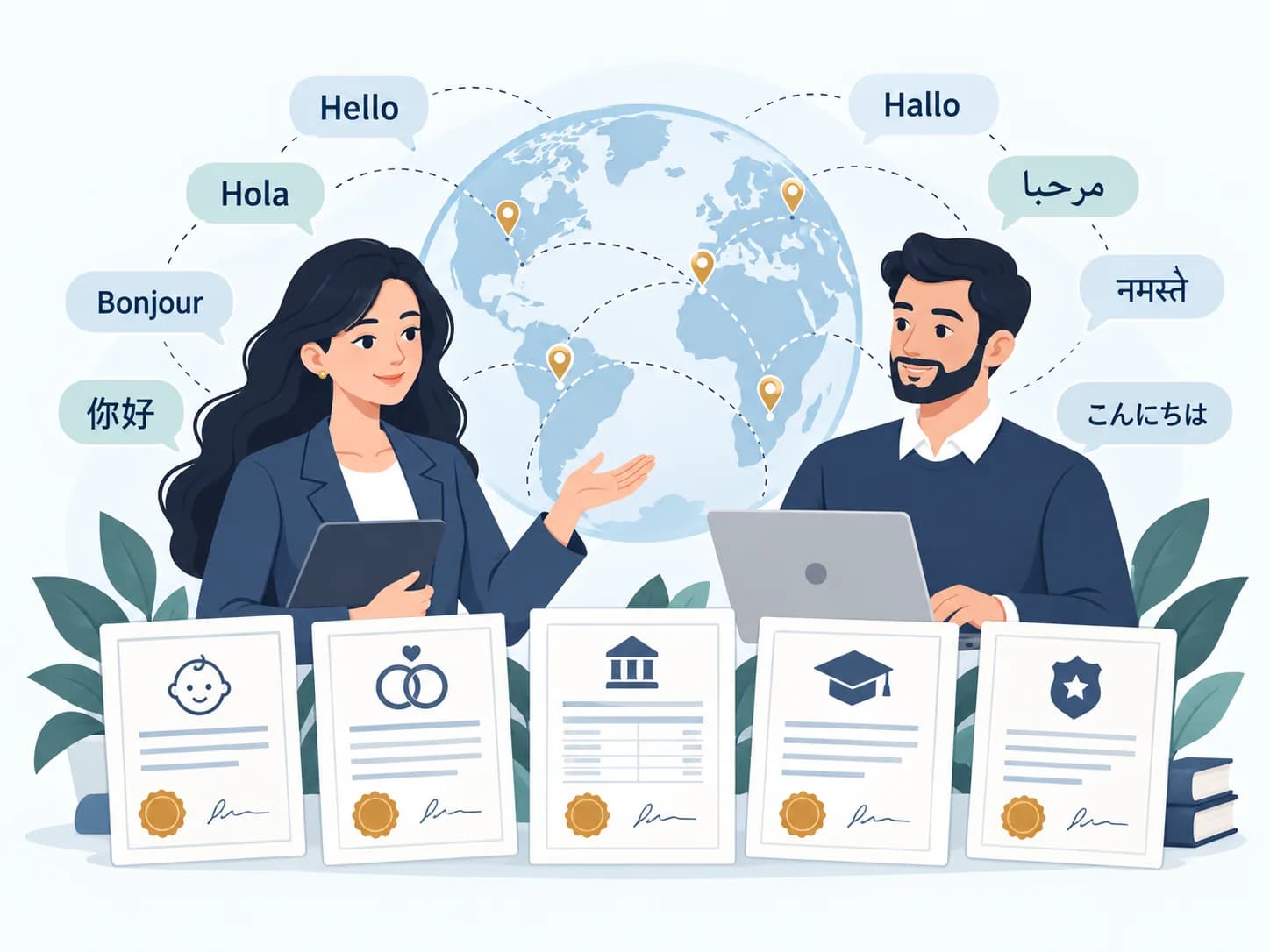
It is a fair question. AI translation tools have improved a lot. For casual reading, travel, or working out what a foreign menu says, they are very good. But a visa application can cost you thousands of pounds in fees. It can also mean years apart from your family. That is not a risk worth taking.
This article explains why immigration authorities reject AI and machine translations. It also covers what they do require, how they spot uncertified work, and what a properly certified translation looks like.
The Core Legal Requirement: A Human Must Sign
What "Certified Translation" Actually Means
A certified translation is not just an accurate translation. It comes with a signed declaration from a qualified human translator or translation company. That declaration says:
- The translation is a complete and accurate version of the original
- The translator is competent in both the source and target languages
- The translator takes personal responsibility for the accuracy
This is the main problem with AI translation for official use: no AI tool can sign a legal declaration. ChatGPT cannot take responsibility. Google Translate has no professional qualifications. DeepL cannot go to court to defend its work. The certification rule is not red tape. It creates a clear chain of accountability that immigration authorities rely on.
UK Visas and Immigration (UKVI), US Citizenship and Immigration Services (USCIS), and Immigration, Refugees and Citizenship Canada (IRCC) all ask for this certified declaration. Without it, they reject the translation. It does not matter how accurate the text is.
What Each Immigration Authority Requires
UKVI (United Kingdom)
The Home Office guidance states that translations must be provided by a "qualified translator" who certifies that the translation is accurate and confirms their qualifications and contact details. There is no approved register, so any qualified human translator can certify. But the key word is "human". AI output with a typed name is not a real certification.
USCIS (United States)
USCIS says every foreign language document must come with a full English translation. The translator must certify that they are "competent to translate from [language] to English" and that the translation is "true and correct." USCIS guidance states clearly that machine-generated translations are not acceptable as certified translations.
IRCC (Canada)
Immigration, Refugees and Citizenship Canada asks for certified translations from a member of a provincial translators' association, or from a non-member who provides certification. The translator must be a person, not a tool. For naturalisation and permanent residence applications, a badly translated document can lead to an interview or a straight refusal.
AI vs Professional Human Translator: Quality Comparison
Put the certification rule aside for a moment. Even on pure translation quality, AI and human translators do very different work on immigration documents. Here is a direct comparison of the things that matter most.
| Dimension | AI Translation | Certified Human Translator |
|---|---|---|
| Legal terminology accuracy | Inconsistent — may use everyday equivalents instead of legal terms | High — trained to use the right legal words for each country |
| Cultural context | Often missing — word-for-word output misses local customs | Strong — understands how naming, titles, and dates differ by culture |
| Formatting preservation | Patchy — plain text output that ignores the original layout | Kept — every field, stamp, and seal note is carried over |
| Name transliteration | Unreliable — creates mismatches with passport spellings | Careful — matches your other official documents exactly |
| Date format handling | Often left in source format or converted inconsistently | Standardised to the target country's format (DD/MM/YYYY for UK) |
| Stamps and official markings | Ignored or translated literally without context | Annotated accurately — [OFFICIAL SEAL], [STAMP: Ministry of…] |
| Certification declaration | Not possible — AI cannot sign or take legal responsibility | Provided — signed declaration with translator credentials |
| Liability for errors | None — the tool bears no responsibility | Professional — the translator takes responsibility |
| Accepted by immigration authorities | No — universally rejected | Yes — accepted by UKVI, USCIS, IRCC, and others |
Real-World Failure Scenarios: What Goes Wrong
The table above may feel abstract. Here are real examples of how AI-translated documents cause visa rejections.
Scenario 1: Legal Terms Mistranslated
A Polish divorce decree contains the term wyrok rozwodowy — literally "divorce verdict." ChatGPT translates it as "divorce sentence." In English, a "sentence" suggests a criminal case. A UKVI caseworker who reads that word may send the application for review.
A qualified translator writes "decree absolute of divorce" instead. That is the correct UK legal term.
Scenario 2: Name Transliteration Creates a Mismatch
Arabic names can be spelled in English in several correct ways. A name like محمد can become "Mohammed," "Muhammad," "Mohamad," or "Mohamed," depending on the AI tool. If the spelling does not match the applicant's passport, immigration officers have reason to doubt the document.
A human translator checks your other documents and copies the spelling you already use officially.
Scenario 3: Dates Left in the Wrong Format
A Chinese birth certificate writes dates as 年/月/日 (Year / Month / Day). Google Translate leaves these as numbers like "1987/03/15." An officer who expects DD/MM/YYYY cannot tell whether this means 15 March or 3 November. That doubt matters when age is part of the decision.
A certified translator writes "15 March 1987" with no ambiguity.
Scenario 4: Honorifics and Titles Lost
Japanese and Korean documents use honorifics and family titles. These titles carry legal weight in family visa applications. DeepL often drops them or makes them all the same. A family registry entry that names a first-born male heir can lose that detail. That can change how a dependent visa is assessed.
Human translators point out these details in the translator's notes.
Scenario 5: Stamps and Seals Ignored
Official documents often carry stamps, seals, side notes, and security features. AI tools treat a document as plain text. A key stamp that reads "Certified true copy — Ministry of Interior" may never appear in the AI output. Immigration officers use these marks to check that a document is genuine.
Certified translations describe every stamp and seal in square brackets, for example [OFFICIAL STAMP: National Registry Office, Karachi].
How Immigration Officers Detect AI Translations
Caseworkers at UKVI, USCIS, and IRCC have handled thousands of applications. They know the signs of an AI-generated translation:
Red Flags That Indicate Machine Translation
- No certification page: A real certified translation always has a separate page with the translator's signed declaration, name, qualifications, and contact details. AI output has none of this.
- Oddly smooth, samey writing: AI writes in one flat style. In a real legal document, different sections use different tones. AI flattens them all into one voice.
- Missing notes: No translator's notes, no bracketed stamp descriptions, and no marks for text that cannot be read or has been blacked out.
- Words that keep changing: AI may use several different English words for the same source word in one document. That shows nobody checked the work.
- Layout ignored: A certified translation follows the layout of the original. AI output is usually one block of plain text.
- Untranslated fields: AI sometimes leaves codes, numbers, or short field labels in the original language with no explanation.
Some authorities now also use document analysis tools to spot AI-generated text. As AI models spread, this checking will only get better. Sending an AI translation is easier to catch every year, so the risk keeps growing.
What a Valid Certified Translation Involves
The difference is accountability. A certified translation is the work of a named professional who checks every line against the original and signs a declaration that it is accurate. A software tool cannot take on that responsibility.
How Certified Translation Works Here (What We Do)
At CertifiedVisaTranslation.com, every certified translation is produced under professional supervision:
- We detect the language and document type and count the pages, so you get an instant quote
- A professional translator translates your document, using specialist tooling built for legal and immigration work — not a general-purpose chatbot
- The translation is checked against immigration terminology checklists
- We add a human-signed certification page with the translator's full qualifications, declaration, and contact details
- We seal the final PDF with a PAdES-LTV signature, so any tampering shows
A qualified person is responsible for every translation we deliver, and signs their name to it. That accountability is exactly what immigration authorities require, and exactly what a general-purpose AI tool cannot give you.
This is not the same as running a document through ChatGPT, printing the result, and signing your own name at the bottom. Some applicants have tried that. It counts as deception on an immigration application and can lead to a ban of up to 10 years in the UK.
When AI Translation IS Acceptable
To be fair, AI translation tools are very useful when you do not need official certification. For example:
- Understanding something yourself: Reading a letter from a foreign government to get the gist before you decide what to do
- Checking documents first: Seeing whether a document even matters before you pay for a certified translation
- Internal business use: Getting the sense of a foreign-language contract before your lawyers read the official version
- Personal travel and communication: Reading menus, signs, casual correspondence, and tourist information
- Research and general reading: Translating academic articles or news for your own use
The difference is what happens if it goes wrong. If only your own understanding is at stake, AI translation is fine. If a visa decision, a court case, or a payment depends on it, you need certified human translation.
The Real Cost Comparison
Free versus paid sounds like an easy win for AI. But the real cost looks very different once you count what happens when things go wrong.
| Scenario | Upfront Cost | Risk Cost | Likely Outcome |
|---|---|---|---|
| AI / Machine Translation | Free | £1,000–£10,000+ | Application refused; fees lost; you must apply again |
| DIY human translation (self-certified) | Free | £1,000–£10,000+ plus possible ban | Rejected and flagged for deception |
| Cheap unqualified translator (online marketplace) | £5–£15/page | £1,000–£10,000+ | High risk of refusal; poor quality; no way to complain |
| Certified professional translation | £20–£30/page | Minimal | Accepted by the authorities; your application moves on |
The Real Numbers Behind a Visa Refusal
- UK Skilled Worker visa application fee: £827–£1,500+
- UK Spouse / Family visa application fee: £1,846
- UK Indefinite Leave to Remain: £2,885
- USCIS Green Card (Form I-485): $1,440
- Canada Permanent Residence: CAD $1,365
- You do not get these fees back if you are refused. Next to that, a certified translation at £60–£100 for 3 pages is cheap.
Frequently Asked Questions
Can I use ChatGPT to translate my documents and then get a bilingual friend to sign the certificate?
No. That counts as deception. The translator who signs must have done the translation and must be competent in both languages. If your friend certifies work they did not do, or work an AI did, they take on legal risk and your application can be marked as fraud. UKVI can impose a 10-year ban for deception.
What about DeepL? It is much better than Google Translate. Surely it is accurate enough?
DeepL is an excellent tool for understanding text. It is very accurate for common European languages. But accuracy is not the only test. The certification rule is absolute. DeepL cannot sign a declaration, cannot take responsibility, and has no qualifications to prove. However good the wording is, without a certified declaration it is not acceptable for official use.
How is your service different from running my document through ChatGPT?
A qualified translator translates, checks and certifies your document, and signs the certification page in their own name. Any tooling our translators use is specialist software built for legal and official documents, not a general-purpose chatbot — and it never replaces the human responsibility that immigration authorities require. That signed human accountability is the thing ChatGPT cannot give you, and the reason an unsigned machine translation gets rejected.
How will the immigration officer know whether I used AI or a human?
The missing certification page is the obvious sign. Caseworkers also spot other clues: no stamp descriptions, names spelled in different ways, writing that reads like AI, no translator's notes, and a layout that does not match the original. If an officer is still unsure, they can ask for the original document and compare the two. An AI translation usually cannot be traced back to a qualified translator you can contact.
I only have one simple document — a one-page birth certificate. Is it really worth paying for a professional translation?
Yes, especially for a single document. A one-page certified translation usually costs £20–£30. That is a tiny part of the visa fee you are protecting. Birth certificates get some of the closest checks in family visa applications, because they prove identity and relationship. Getting this one document right matters more than almost anything else you send.
The Bottom Line
AI translation tools — ChatGPT, Google Translate, DeepL, and the rest — are useful products. They have changed how people read content in other languages. For personal use, informal messages, and general understanding, they are excellent.
For visa applications they are not just weak. They are dangerous. They fail the basic legal rule of human certification. They add errors that caseworkers spot. And they put fees you cannot get back at risk.
The safe way to use AI in certified translation is as a checked tool that helps qualified professionals. It must never be a shortcut around them. That way you get the speed and low cost of AI, and still meet the standards immigration authorities require.
If you are preparing a visa application, do not take the risk. Use a certified translation service, check that the certification page is there and complete, and submit with confidence.
Related Services
Continue Reading
Can I Translate My Own Documents for a UK Visa?
The rules on self-certification, when family members can translate, and the risks of non-professional translations.
What Is a Certified Translation?
A complete guide to certified translation — what it is, what it must contain, and who is authorised to provide one.
Why UKVI Rejects Translations: 10 Common Mistakes
The most common translation errors that lead to visa rejections and exactly how to avoid each one.
Get a Certified Translation That Actually Works
Translated and certified by professional translators, and accepted by UKVI, USCIS, IRCC, and other immigration authorities around the world. Upload your document for a quote in seconds.
Get Your Certified TranslationRelated Articles
Can I Translate My Own Documents for a UK Visa?
Rules on self-certification and why immigration authorities generally require a qualified independent translator.
What Is a Certified Translation?
Everything you need to know about what makes a translation "certified" and what components it must include.
Why UKVI Rejects Translations
The 10 most common translation mistakes that cause UK visa rejections — and how to avoid every one of them.