
USCIS Translation Mistakes That Get Applications Denied
One translation error can trigger an RFE, delay your case by months, or get it denied. Here are the 8 mistakes USCIS sees most often, and how to avoid each one.
USCIS handles millions of immigration applications each year. Many of them include documents in other languages. Under 8 CFR 103.2(b)(3), every foreign-language document needs a full English translation and a certification from the translator. Get it wrong and you will get a Request for Evidence (RFE), or even a denial.
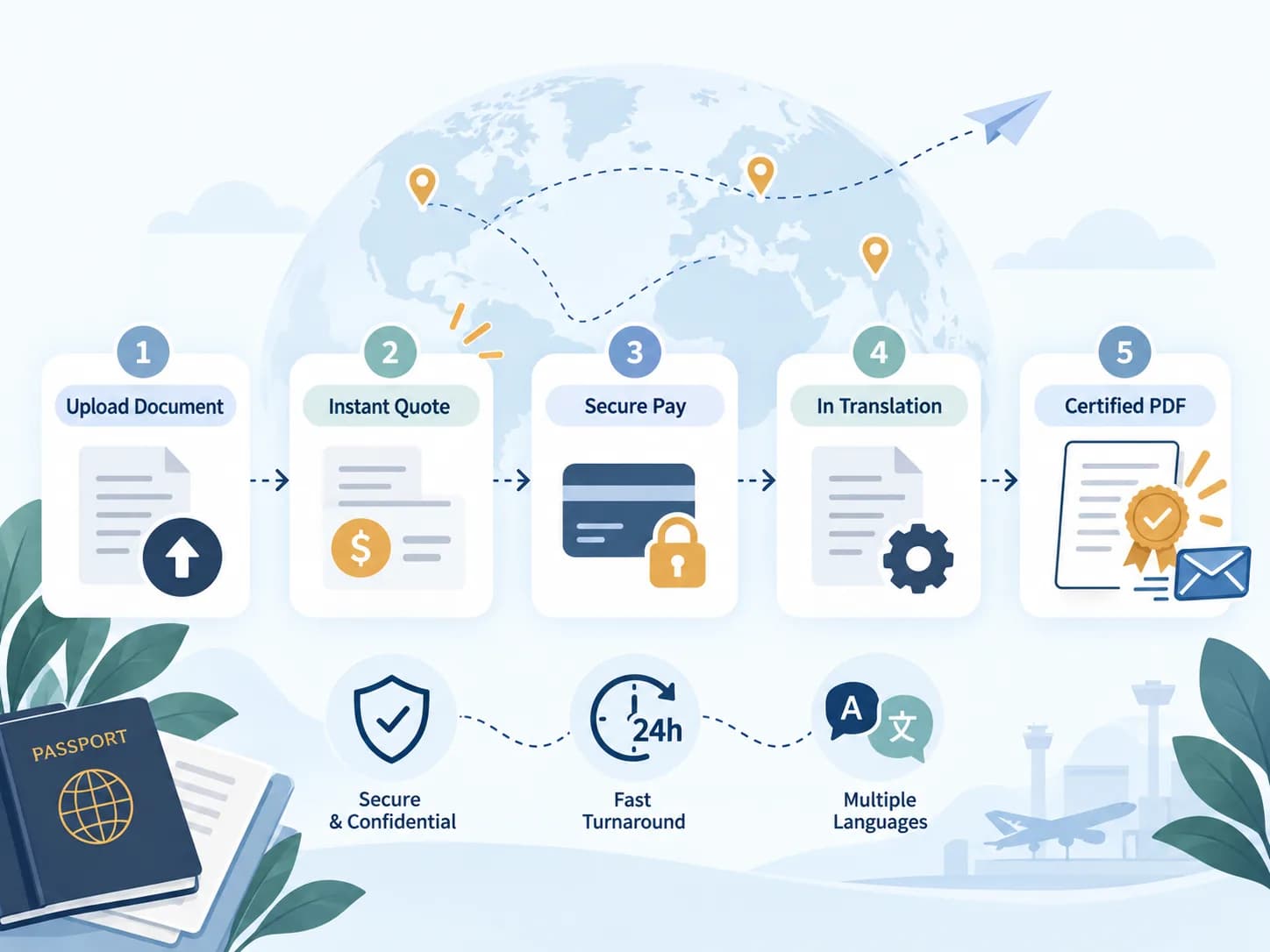
This guide covers the 8 most common translation mistakes we see in USCIS applications. Each one comes with real examples and a clear fix.
The 8 CFR 103.2(b)(3) Requirement
What the law actually says
8 CFR 103.2(b)(3) states: "Any document containing foreign language submitted to USCIS shall be accompanied by a full English language translation which the translator has certified as complete and accurate, and by the translator's certification that he or she is competent to translate from the foreign language into English."
So you need three things: a complete translation, a certification of accuracy, and a certification of competence. Miss any one of them and your translation does not comply.
Mistake #1: Missing or Incomplete Certification Statement
The most common mistake
The translation is accurate, but the certification statement is missing. Or the statement leaves out one of the required parts. USCIS will send an RFE asking for a properly certified translation, even when the translation itself is perfect.
A certification statement that meets USCIS rules must include:
- A statement that the translation is complete and accurate
- A statement that the translator is able to translate from [language] into English
- The translator's printed name
- The translator's signature
- The date of certification
USCIS-compliant certification statement template
I, [Full Name], certify that I am competent to translate from [Source Language] to English, and that the above/attached translation of [Document Type] is complete and accurate to the best of my knowledge and ability.
Signature: ___________________
Printed Name: [Full Name]
Date: [Date]
Address: [Translator's Address]
Phone/Email: [Contact Information]
Mistake #2: Translator Certifying Their Own Documents
The family member trap
Unlike UKVI, USCIS does not formally ban you or a family member from translating your own documents. Even so, most immigration attorneys advise against it. A USCIS officer may doubt how neutral and accurate the translation is, especially if they later spot a mismatch.
8 CFR 103.2(b)(3) only asks the translator to certify their competence. Still, a translation done by you, your spouse or a close relative looks suspect. If USCIS questions the accuracy while reviewing your case, that family link makes your evidence weaker.
Best practice
Always use an independent, professional translator. Professional translation costs little next to an RFE or a denial that delays your case by 3-6 months.
Mistake #3: Incomplete Translation (Summaries Instead of Full Text)
Partial translations don't count
A summary, or just the "important parts", breaks the "full English language translation" rule. USCIS expects every word, stamp, seal, note and margin comment to be translated.
This mistake is particularly common with:
- Long academic transcripts — the cover page gets translated but the course list does not
- Birth certificates with notes in the margin — the main text gets translated but changes are ignored
- Court documents — the judgment gets translated but the stamps, case numbers and endorsements do not
- Bank statements — the account details get translated but the small print does not
Mistake #4: Paying for Notarisation When You Don't Need It
A costly misconception
Many applicants think USCIS wants notarised translations. It does not. The rule, 8 CFR 103.2(b)(3), asks only for a certification from the translator. Notarisation adds $20-50+ per document and gives you nothing extra on a standard USCIS application.
There are still a few times when notarisation is needed or useful:
| Situation | Notarisation Needed? | Why |
|---|---|---|
| Standard USCIS applications (I-130, I-485, N-400) | No | Certification statement is sufficient |
| US state court proceedings | Often yes | State courts may have their own requirements |
| Immigration court / EOIR | Depends on judge | Some immigration judges prefer notarised translations |
| Attorney request | If advised | Some attorneys prefer it for additional credibility |
Mistake #5: Name Transliteration Inconsistencies
Different names across documents
Names in Arabic, Chinese, Cyrillic or Hindi can be spelled in English in several ways. Two translators may pick two different spellings. If your birth certificate says "Muhammad", your marriage certificate says "Mohammed" and your passport says "Mohamed", USCIS may ask whether these are the same person.
The fix is simple. Use the same translator or service for every document in your application. A professional service keeps the spelling the same across all your papers and matches your passport, which is your main identity document.
Mistake #6: Date Format Confusion
DD/MM/YYYY vs MM/DD/YYYY
A date written as "03/04/1990" means April 3 in the US, but March 4 in most other countries. If the translator does not make the format clear, USCIS may read the date wrongly. That can make ages look wrong, or make marriage and birth dates clash.
A professional translator will write the date out in full, such as "April 3, 1990", or state which format the original used. This matters most for documents from countries that use DD/MM/YYYY, which covers most of Europe, Asia and Africa, or YYYY/MM/DD, used in East Asia.
Mistake #7: Missing Translation of Stamps, Seals, and Annotations
Everything on the page must be translated
Government stamps, raised seals, watermarks with text, handwritten notes in the margin and official endorsements all carry information. A round stamp reading "Ministry of Foreign Affairs — Certified Copy" in Arabic must be translated, not skipped.
If a stamp or seal cannot be read, the translator should say so. For example: "[Illegible round stamp]" or "[Partially illegible seal, visible text reads: ...]". Leaving stamps out makes the translation look incomplete to USCIS.
Mistake #8: Submitting Machine/AI Translation as Certified
Google Translate with a signature doesn't count
Some people run a document through Google Translate, ChatGPT or DeepL, then have someone sign the certification. That person did not do the translation, so the statement is false. USCIS officers are trained to spot machine translation. The signs are odd phrasing, terms that change from line to line, and a layout that does not match the original.
The certification statement asks the translator to confirm that they can translate the document. Signing one for a machine translation is a false statement. That can cost you more than an RFE. It can cast doubt on your whole application.
The Real Cost of a Translation RFE
An RFE about translation may sound like a small problem. The real cost is high:
| Impact | Details |
|---|---|
| Processing delay | 3-6 months added to your case timeline |
| New translation cost | $20-50+ per page for a compliant replacement translation |
| Attorney fees | $200-500+ for attorney to prepare and submit RFE response |
| Work authorisation gap | EAD renewal delays if I-485 is pending |
| Emotional stress | Uncertainty about case outcome during the delay |
| Potential denial | Miss the 87-day RFE deadline and your case is denied automatically |
Common USCIS Forms and Their Translation Requirements
| Form | Purpose | Commonly Translated Documents |
|---|---|---|
| I-130 | Petition for Alien Relative | Birth certificates, marriage certificates, divorce decrees |
| I-485 | Adjustment of Status | Police certificates, military records, court documents, medical records |
| N-400 | Application for Naturalization | Tax returns, arrest records, all identity documents from every country |
| I-140 | Immigrant Petition for Worker | Academic degrees, transcripts, employment letters, professional licences |
| I-129F (K-1) | Petition for Fiancé(e) | Birth certificates, divorce decrees, police certificates, evidence of relationship |
| I-589 | Application for Asylum | Identity documents, evidence of persecution, country condition evidence, medical reports |
USCIS vs UKVI: Key Translation Differences
If you know the UK visa translation rules, here is how USCIS differs:
| Requirement | USCIS | UKVI |
|---|---|---|
| Legal basis | 8 CFR 103.2(b)(3) | Immigration Rules, Appendix FM |
| Self-translation | Technically allowed (not recommended) | Not accepted — must be independent |
| Notarisation | Not required (but sometimes requested) | Not required |
| Translator qualifications | Self-certified competence | Professional qualifications expected |
| Certification format | Specific wording required (competence + accuracy) | Declaration of accuracy + translator details |
| Rejection process | RFE issued (87 days to respond) | Application may be refused outright |
How to Fix a Rejected Translation
If you have received an RFE about your translations, here is how to respond:
Read the RFE carefully
USCIS will say exactly what is wrong. It may be a missing certification, a part-finished translation, or one document that needs redoing.
Get a fresh translation from a professional service
Do not patch up the old translation. Start again with a service that knows the USCIS rules.
Submit ALL requested items within the 87-day deadline
If you miss the RFE deadline, your case is denied automatically. If several documents need redoing, start at once and do the most important first.
Include a cover letter with your response
Quote the RFE notice number and explain what you are sending to fix each problem.
Pre-Submission Checklist
Before submitting your USCIS application, verify:
- • Every foreign-language document has a full English translation
- • Each translation has a certification statement with every required part
- • The certification includes both accuracy AND competence statements
- • The translator's name, signature, and date are on each certification
- • Names are spelled consistently across all translations
- • Dates are clear, written out in full or in an obvious format
- • All stamps, seals, and annotations are translated
- • Translations are complete, with no summaries and no missing parts
- • Translations are clearly matched to their original documents
- • You've included both the original AND the translation for each document
Frequently Asked Questions
Does USCIS have an approved list of translators?
No. Some countries keep such a list, but USCIS does not. Anyone who certifies that they can work in both languages may provide a certified translation. A professional service still cuts your risk of errors by a lot.
Can I submit the same translation to USCIS and UKVI?
Possibly, but check the certification statement first. USCIS wants specific wording about "competence", and UKVI certifications often leave it out. It is safer to get a translation that meets both standards, or a separate certification for each.
What if my document is in a language with very few translators?
For rare languages, USCIS is more flexible about who can certify competence. The certification rules stay the same, though. Online services can usually find a translator for a rare language pair faster than a local agency.
How long is a USCIS translation valid?
USCIS translations do not expire. But if the original document has been replaced, translate the newest version. That applies if you have a new passport, or if your birth certificate has been amended.
What happens if I miss the 87-day RFE deadline?
Your application will be denied. You would then have to file again, with new fees, new translations and possibly new supporting documents. That can set your case back a year or more. Always answer an RFE quickly.
Related Services
Continue Reading
USCIS Certified Translation Requirements: Complete 2026 Guide
The complete guide to USCIS translation requirements — everything you need to know before submitting your application.
Why UKVI Rejects Translations: 10 Common Mistakes to Avoid
The UK equivalent — common translation mistakes for UK visa applications.
What Is a Certified Translation?
Everything you need to know about certified translation standards across different immigration systems.